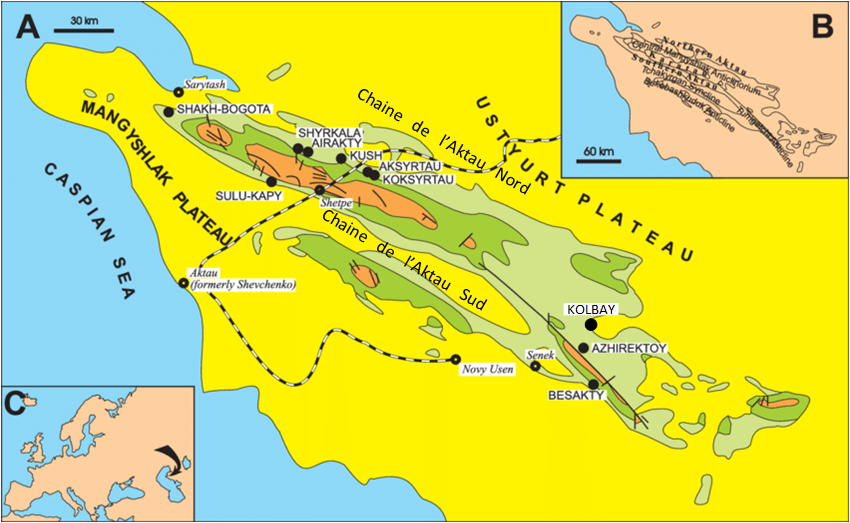
Localisation. The Mangyshlak is a 300 km eroded anticlinorium in the northeast of the Caspian Sea, in the Mangystau Province of western Kazakhstan. The adjacent map is from Marcinowski et al. (1996), who also include photos of outcrops in the region. Additional maps are provided by Gruszczinsky et al. (2002), Kennedy and Walaszczyk (2025), and Blackbourn Consulting (2007).
On the map, the Tertiary is shown in yellow, the Lower Cretaceous in dark green, the Upper Cretaceous in light green, and older sediments in orange. The anticlinorium includes a central range, the Karatau, formed of dark Permo-Triassic rocks (orange block). It is flanked by two long cretaceous valleys, between the Tertiary ranges of North Aktau and South Aktau. A shorter anticline centered on a small Jurassic massif lies beneath the South Aktau range. The landforms are often ruiniform in appearance, due to erosion, and the maximum elevation is only 550 m, in the Karatau. A few classic Albian sites are marked by black dots on the map. The only major city are Aktau in the southwest, on the shore of the Caspian Sea (population 262,000), along with Novy Usen (population 148,000).
Literature on Mangyshlak Cretaceous and Albian. The Cretaceous was explored for phosphates by Andrussov (1911). More recently, it has motivated stage-by-stage analysis, including the Valanginian (Luppov et al., 1983), the Berriasian (Luppov et al., 1988), and the Albian (Prozorovsky, 1989). Saveliev and Vassilenko (1963) and subsequently Saveliev (1956, 1971) studied the Lower Cretaceous in general, while Marcinowski et al. (1996) and later Gruszczinsky et al. (2002) addressed the Middle Cretaceous. The whole Cretaceous has even been the subject of a synthesis (Kopaevich et al., 1999).
Semenov (1899), Sinzow (1907), and Litschkov (1927) were the first to study the regional Albian, followed by other Russian authors such as Glazunova (1953), Sokolov (1967), and, above all, Anatoli Antonovich Saveliev (1956, 1960, 1963, 1973a, 1973b, 1974, 1981, 1992). More recently, European researchers have also taken an interest in the region, like Cecca (1997) and Kennedy et al. (2008).
Other Albian outcrops exist in Transcaspia (east of the Caspian Sea, including Mangyshlak) and even further east, beyond the Amu Darya River, such as the Gissar Mountains, which span Uzbekistan and Tajikistan. The finest Transcaspian outcrops are found in a series of small mountain ranges, from north to south: the aforementioned Mangyshlak in Kazakhstan; the Tuarkyr, Great Balkhan, and Little Balkhan in Turkmenistan; and the Kopet-Dag, which runs along the Turkmenistan-Iran border. Albian ammonites from Mangyshlak are thus retrieved in these massifs, and we have been able to gather descriptions from Russian and Iranian works focused on these regions: Glazunova (1960) for Transcaspia; Glazunova (1952), Ilyin (1961), and Mirzoev (1970) for Turkmenistan; Glazunova (1949) and Mosavinia et al. (2014) for the Kopet-Dag (Koppeh Dagh in Persian); and Luppov (1961) and Mirzoev (1967, 1969) for the Gissar Mountains (Hissar in Uzbek).
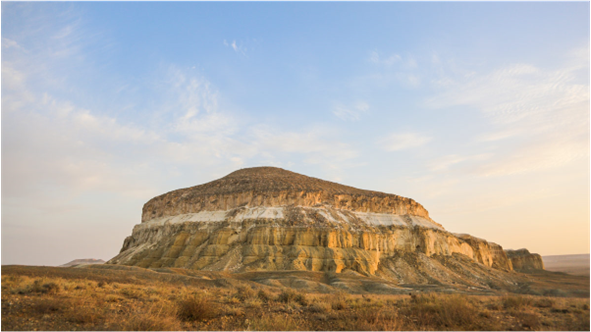
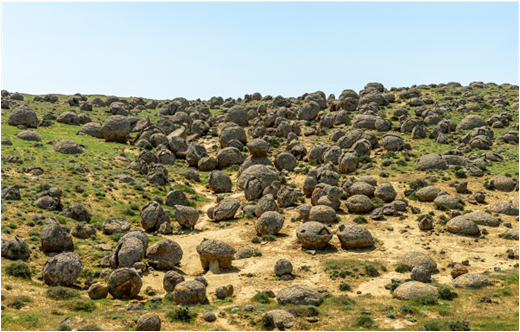
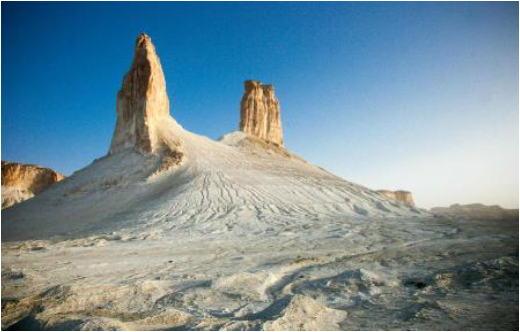
The following photographs illustrate some of the magnificent landscapes of Mangyshlak, reminiscent of the canyons of Colorado and Utah (Monument Valley). The first shows Mount Shyrkala (or Sherkala), a stack of strata ranging from Upper Albian to Lower Santonian. The second shows Torysh, aka the "the Valley of Balls", located 30 km west of Mount Sherkala. It exhibits hundreds of sandstone concretions in Aptian sands. These fossil-rich spheres reach up to two meters in diameter.
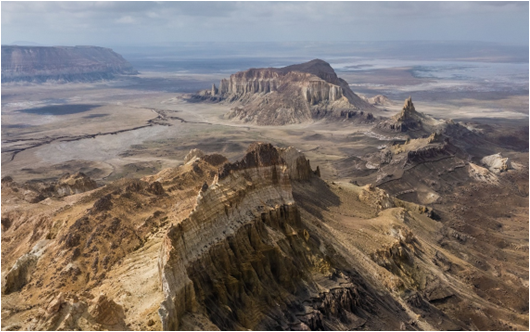
The third photo covers the Mount Airakty area, aka the "Valley of Castles" due to its impressive outliers that have been deeply sculpted by erosion. Mount Airakty, flanked by a huge boulder slope, appears in the background at the center. The final shot shows the Boszhira site, located east of Besakty on the eastern side of the Mangyshlak anticlinorium. It comprises a complex of canyons, cliffs, and limestone needles that incise the edge of the Ustyurt Plateau. The image highlights the site's two most famous formations: a pair of 200-meter-high peaks known as the "Fangs of Boszhira."
Albian outcrops and fauna. According to Kopaevich et al. (1999), the Caspian region during the Albian was a large, shallow basin open to the Tethys but relatively isolated from the open ocean, and subject to frequent boreal incursions. Albian sedimentation ranges from 132 to 998 meters in thickness, depending on the sites (Saveliev, 1971). It is interrupted only by brief hiatuses, marked by phosphatic horizons. These hiatuses occur primarily in the Upper Albian, whereas the Lower Albian succession is virtually complete. It is therefore possible to trace the full evolution of certain Lower Albian genera, such as Sonneratia and Protohoplites that are only known from condensed horizons in Western Europe. The Albian consists predominantly of silty clays, sands, and sandstones. Beds of marl and limestone are common in the Upper Albian. The main fossiliferous outcrops cited in the literature (see map) are located primarily in the northern valley; these include Shakh-Bogota, Shyrkhala, Airakty, Kush, Aksyrtau, and Koksyrtau. There are also a few sites to the east of the anticlinorium, such as Azhirektoy, Besakty, and Kolbay.
The ammonite fauna of Mangyshlak early Albian (Leymeriella tardefurcata and L. regularis zones) is treated in a book by Saveliev (1973). This author describes the remainder of the Lower Albian, the super-zone of Cleoniceras mangyshlakense, in another book published in 1992, which synthesizes and updates numerous earlier studies. The Middle Albian has been less studied, for instance by Saveliev (1976) and Kennedy & Walaszczik (2025). In contrast, the literature on Upper Albian is fragmented across a multitude of articles, for example Glazunova (1953a, 1960), Luppov (1961), Sokolov (1961, 1967), Mirzoev (1970), Marcinowski (1983), Mikhailova & Saveliev (1994), Marcinowski et al. (1996), Cecca (1997), Kennedy et al. (2008), and Kennedy & Walaszczik (2025).
The ammonite fauna shares certain genera with the Anglo-Paris Basin, such as Anahoplites, Beudanticeras, Callihoplites, Douvilleiceras, Hoplites, Isohoplites, Leymeriella, Lyelliceras, Otohoplites, Protohoplites, Pseudosonneratia, and Sonneratia. But it also includes genera that are rare in Western Europe, like Anadesmoceras, Karamaiceras, Tetrahoplites, and Semenoviceras, and even polar forms such as Arcthoplites. It already differs from the Tethyan fauna found nearby in the Caucasus, on the other side of the Caspian Sea. For instance, the genera Eogaudryceras, Kosmatella, Phylloceras, Puzosia, and Tetragonites are not reported in Mangyshlak. The photographs below show three endemic species from the Lower Albian of Mangyshlak, described on this site.


For a long time, ammonites from Mangyshlak were unknown at western fossil shows. However, between 2000 and 2010, a Kazakh individual from Aktau extracted Albian specimens from classic Mangyshlak sites such as Koksyrtau and Besakty. He also discovered a new Lower Albian deposit yielding beautiful fossils packed in nodules of very fine-grained, hard sandstone, light gray in color with a brown cortex. The exact location in the anticlinorium northern valley is naturally kept secret by the discoverer, who exported numerous specimens resold for instance by vendors like Lithologia and Kamyk. Unfortunately, this prospector was forced to halt his activities due to health issues. Furthermore, a planned geopark project will likely ban fossil collecting.
Ammonite zones. The zonation of the Albian of Mangyshlak has been progressively refined since the 1950s, through the successive works of Saveliev. Although based at VNIGRI in St. Petersburg (in English the All-Russian Petroleum Research Exploration Institute), this author made numerous trips to Mangyshlak, bringing back a large number of ammonites. The following table presents the most recent version of the zonation (Saveliev, 1981, 1992; Prozorovsky, 1989). We have retained the species names used by Saveliev, adding comments below the table. We added the final column to correlate Saveliev's zones with the phyletic zonation established by Amédro (1992) for the Anglo-Paris Basin (APB). The correlations for the Lower and Middle Albian are fairly precise. However, they are approximate for the Upper Albian, as the faunal lists for certain zones or subzones defined by Saveliev do not include species known in Western Europe.
| Albian | Super-zone | Zone | Subzone | Other common species | APB zones |
|---|---|---|---|---|---|
| Upper | Lepthoplites cantabrigiensis | Lepthoplites cantabrigiensis | Pleurohoplites studeri | P. renauxianus, Callihoplites tetragonus, Karamaiceras kolbajense, Arrhaphoceras sp. | fallax-perinflatum |
| Callihoplites vraconensis | Callihoplites advena, Karamaiceras kolbajense, Arrhaphoceras sp. | ||||
| Semenovites 1 | Pervinqueria inflata | Semenovites uhligi & tenuis, Pervinquiera subinflata, Hysteroceras sp. | inflatum | ||
| Semenovites michalskii | Semenovites laticostatus, Euhoplites sp. | cristatum-pricei | |||
| Semenovites litschkovi | S. pseudocoelonodus | S. mangyschlakensis | cristatum | ||
| S. tamalakensis | Callihoplites sp., Anahoplites solidus | ||||
| Middle | Anahoplites | A. rossicus 11 | Anahoplites biplicatus, obliquecostatus et solidus | biplicatus | |
| Hoplites perarmatus 8 | Hoplites armatus, Anahoplites asiaticus, transcaspius & allae, Daghestanites2 daghestanensis & mangyschlakensis, Dimorphoplites niobe | niobe | |||
| A. intermedius | Anahoplites praecox, Dimorphoplites solidus | intermedius | |||
| Hoplites | Hoplites dentatus | Hoplites spathi 7 | H. rudis & escragnollensis | dentatus | |
| Lyelliceras lyelli | Lyelliceras pseudolyelli, Hoplites bullatus 6 | benettianus | Pseudosonneratia (Isohoplites) steinmanni 4 | Dimorphoplites akmyschensis 5 | steinmanni |
| Lower | Cleoniceras 13 (Neosaynella) mangyschlakense (with Beudanticeras newtoni et Douvilleiceras mammillatum) |
Otohoplites sinzowi | Otohoplites crassus | Otohoplites salebrosus, subcrassus, subhilli, subchloris & waltoni Cleoniceras (Neosaynella) mirabilum, Protanisoceras vaucherianum | subhilli | Protohoplites (Hemisonneratia) puzosianus |
Tetrahoplites dragunovi, finitimus, orientalis, suborientalis, subquadratus & rossicus Sonneratia (S.) dutempleana, intermedia, kulatensis, sexangula & subdutempleana Pseudosonneratia jacobi, kalugini & occidentalis, B. arduennense, dupinianum & laevigatum, Protohoplites (P.) archiacianus, P. (H.) gallicus, cantianus & transitorius | puzosianus | Sonneratia vnigri | Sonneratia caperata 12,14 | Sonneratia (Eosonneratia) luppovi, media, tenuis & titovi, Cleoniceras renatae | floridum | Sonneratia rotula | Sonneratia (E.) subtranscaspia, S. (Globosonneratia) perinflata, Beudanticeras revoili | Sonneratia solida 15 | Anacleoniceras bicostatum, Sonneratia (E.) kitchini, Cleoniceras planum | kitchini | Sonneratia globulosa 9 | Sonneratia (Eosonneratia) gribkovi, sarasini & tumida, Cleoniceras obtusum | Leymeriella | Leymeriella (Neoleymeriella.) regularis | L. (N.) pseudoregularis & consueta, Vnigriceras 3 (V.) kelendense & sinzowi, V. (Astrodiscus) insegestum & bicurvatoides, Anadesmoceras acutum | regularis | Leymeriella (Leymeriella.) tardefurcata | L. (L.) germanica, acuticostata & weberi, Arcthoplites subjachromensis & nikitini, Anadesmoceras matutinum | tardefurcata |
List of the 32 Mangyshlak ammonite species described on this website