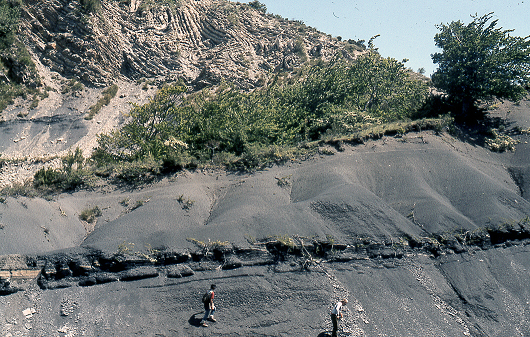
General. The Albian stage was defined by d'Orbigny (1842). Its name comes from the Aube River (alba in Latin), which flows through its formations. This stage is the longest of the Cretaceous period, along with the Aptian: from 112 million years ago (Ma) to 99.6 Ma BC, so 12.4 Ma (Ogg et al., 2004). The picture shows the famous Albian blue marls with the fossiliferous Paquier level (darker), in the southeastern Alps (Delamette, 2017). The table shows the Albian within the Cretaceous period, with ages before Christ.
Zonation. There exist several subdivisions (zonations) of Albian, depending on the region of the globe and the local species. This button describes Amédro's phylogenetic zonation (1992), valid for the Anglo-Paris Basin and based on the evolution of hoplitids.
Albian outcrops. The Stratotype button presents the Albian layers in Aube department, which are similar in Marne and Meuse departments. Two different Albian regions of France are described by the Wissant and Yonne buttons. For foreign countries, we propose a Folkestone button, for the best-known Albian site in England, a Madagascar button, for the pearly ammonites seen on the web and in fossil exhibitions, and a Kazakhstan button for the Albian of Mangistau, in the west of that country.
| Cretaceous | Stage | Duration (Ma) |
|---|---|---|
| Upper | Maastrichtian | 70,6 - 65,5 |
| Campanian | 83-5 - 70,6 | |
| Santonian | 85,8 - 83,5 | |
| Coniacian | 89,3 - 85,8 | |
| Turonian | 93,5 - 89,3 | |
| Cénomanian | 99,6 - 93,5 | |
| Lower | Albian | 112,0 - 99,6 |
| Aptian | 125,0 - 112,0 | |
| Barremian | 130,0 - 125,0 | |
| Hauterivian | 136,4 - 130,0 | |
| Valanginian | 140,2 - 136,4 | |
| Berriasian | 145,5 - 140,2 |