Created 2024/02/29
Updated 2025/06/12
Cleoniceras (Neosaynella) mangyschlakense Luppov, 1949
| Measurements |
D mm | H/D | T/D | O/D | H/T |
|---|
| Neotype Saveliev 1992 | 70.0 | 0.56 | 0.25 | 0.11 | 2.24 |
| CP-399 | 99.7 | 0.55 | 0.22 | 0.15 | 2.58 |
| CP-400 figured
| 106.5 | 0.55 | 0.22 | 0.12 | 2.22 |
| CP-398 | 135.9 | 0.54 | 0.24 | 0.11 | 2.23 |
| 2639 Saveliev 1992 | 164.0 | 0.53 | 0.22 | 0.11 | 2.41 |
| Age |
Origin |
|---|
Sandstone nodules in sands
C. mangyschlakense superzone
Lower Albian
|
North Aktau Ridge
Mangystau Peninsula
Kazakhstan
|
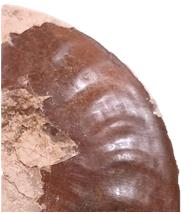
Description.
A beautiful, complete specimen with a pearly test preserved on one side, without visible sutures. The aperture, with its oblique peristome, and the umbilicus are obstructed by hard sandstone whose removal is too risky. The shell is very flat; its whorls, 80% covered, have a very high, lanceolate section. The very narrowly rounded, almost acute venter widens at the end of the spire. The only sculpture is formed of fine, proverse, and falcate growth lines. However, in raking light, faint concave crescents are visible in the outer third of flanks, discernible at the beginning of last whorl in the profile view. They are more exposed on the side without test (photo on the right, the aperture is downwards). There are 26 of them on the last whorl.
According to Saveliev (1992), the body chamber occupies half of last whorl and widens slightly near the aperture.
Remarks.
Species defining a superzone in the Lower Albian of Mangystau (Saveliev, 1981, 1992). The nearly smooth flanks are typical of subgenus Neosaynella. Casey (1966) considers it a synonym of Cleoniceras (Neosaynella) platidorsatum (Sinzow, 1910). But according to Saveliev (1992), the latter has a thin, flat band on the siphon at all ages. In addition, its suture is different. C. (N.) inornatum Casey (1954) also has this flat band, but only in juveniles. Saveliev (1992) confidently assigns to the species mangyschlakense the C. (N.) aff. platidorsatum (Sinzow) described by P. Destombes (1979) and coming from the Perchois-Ouest quarry (Aube).


