Created 2023/03/03
Updated 2026/01/22
Tetrahoplites orientalis Casey, 1952
| Measurements |
D mm | H/D | T/D | O/D | H/T |
|---|
| CP-406 |
44.7 | 0.43 | 0.42 | 0.29 | 1.02 |
| Sinzow holotype |
57.5 | 0.41 | 0.38 | 0.29 | 1.06 |
| CP-412/146 |
71.9 | 0.39 | 0.38 | 0.33 | 1.01 |
| Age |
Origin |
|---|
sinzowi zone, puzosianus sz
of Mangystau, Lower Albian
|
North-Aktau Ridge
Mangystau, Kazakhstan
|
| Ratio | T. subquadratus | T. orientalis |
T. suborientalis |
|---|
| H/T | 0.82 – 0.95 | 1.01 – 1.06 | 1.17 – 1.31 |
| T/D | 0.42 – 0.45 | 0.38 – 0.42 | 0.32 – 0.36 |
Description.
The whorls of this slightly evolute ammonite overlap by 45% and increase slowly in thickness. The slightly compressed section is rectangular, with slightly converging flanks. The body chamber is on the last half-whorl. The straight umbilical wall at 50° quickly rounds toward the flank. Its edge bears 14 bullae of unequal length, giving 24 ribs in pairs, slightly arcuate or weakly sigmoid. They are sharp, steeper behind, increasingly elevated and spaced toward the aperture, and cross the venter with a weak and broad sinus. Some pairs are very divergent. A few ribs are detached from their umbilical bulla or inserted between two successive pairs.
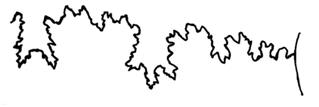
The filiform sulcus common in the genus is visible in raking light, from the beginning of the last whorl. It evolves towards a very weak but wider coastal depression near the aperture. We show on the right the unpublished suture line (CP-412/146 at 55 mm).
Remarks.
Known in Magystau only. Casey (1952) defined Tetrahoplites for certain ammonites from plate III of Sinzow (1907), with T. subquadratus for the Sonneratia subquadrata of figures 7-8, and T. orientalis for the S. jachromensis of figures 9-10. Saveliev (1973) then created T. suborientalis for the S. jachromensis of figures 12 and 18. We have compiled the dimensions of all published specimens in the lower table: we are perhaps dealing with a single species with three variants. Thanks to Laurent Zimmer (Lithologia) who translated the German description of S. jachromensis by Sinzow!


