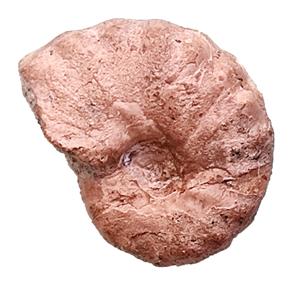
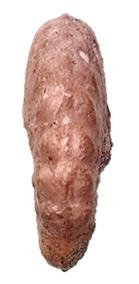
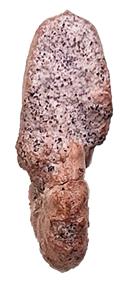
Neophlycticeras (Neophlycticeras) brottianum (d'Orbigny, 1841)
| Measurements |
D mm | H/D | T/D | O/D | H/T |
|---|
| MHNG 54428c* |
19.9 | 0.46 | 0.31 | 0.24 | 1.50 |
| RJ-368 |
20.8 | 0.52 | 0.35 | 0.21 | 1.50 |
* Specimen in Kennedy & Delamette (1994a)
| Age |
Origin |
|---|
Phosphatic-glauconitic sand
cristatum to inflatum zones
Upper Albian condensed level
|
Disused phosphate mine
Valserhône (ex-Bellegarde)
Ain, France
|
Description.
A small, worn ammonite, very involute, made of glauconitic sandstone covered with a beige phosphate test, without visible suture lines. Whorls 90% covered, with a high trapezoidal section and a tectiform venter. Small umbilicus with a quarter-circle wall. The worn ribs are only clearly visible in raking light. They include 10 long, proverse, and slightly sigmoid ribs, which arise singly or in pairs on the umbilical wall and then thicken towards venter. In addition, there are 6 shorter ribs, which begin at varying heights but then become similar to the long ones. The 16 ribs in total develop a large, blunt ventrolateral bulla and cross the venter while forming a thin siphonal clavus. These clavi are connected in the intercostal spaces by a lower ridge, resulting in a sort of undulating keel.
Remarks.
Most of the specimens illustrated by Kennedy & Delamette (1994a) are thicker and have narrower, closer, and more numerous ribs, with less pronounced ventrolateral tubercles. The thickest forms also have the greatest number of ribs, like the d'Orbigny holotype illustrated on the genus entry. But Kennedy and Delamette emphasize the great variability of the species: with its more compressed whorl section and reduced number of ribs, with big ventrolateral bullae, RJ-368 more closely resembles their specimen in Fig. 8, Y-Z.