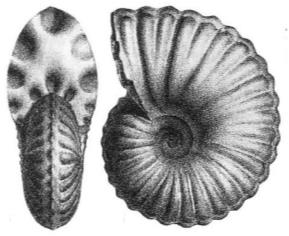
Description. According to Wright (1996), this genus is moderately to very involute, more or less compressed, with flat or convex flanks and flattened or broadly rounded ribs crossing the more or less fastigiate venter. The venter is acute and crenulated, or rounded with a row of siphonal tubercles. The subgenus Eotropitoides proposed by Casey (1965) for forms with ribs effaced at mid-flank and siphonal tubercles tending to form a keel is not necessary. Lower Cretaceous (Middle and Upper Albian), Western Europe, Morocco, Madagascar, Japan, Colombia, Peru, Ecuador, Venezuela.
Subgenera and species. The subgenus Neophlycticeras sensu stricto reaches 73 mm. It sometimes has faint umbilical tubercles. Its ventrolateral ribs and tubercles taper on the body chamber. Neophlycticeras (Neophlycticeras) brottianum (d'Orbigny, 1841) was revised by Kennedy & Delamette (1994a). It is more or less compressed, with an ovoid section. Its radial ribs, quite numerous and closely spaced, originate at the umbilical suture and then become spatulate on the upper flanks, as in Oxytropidoceras (Mirapelia). These ribs bear a small siphonal clavi, forming an undulating ventral keel. The drawings by d'Orbigny shown here illustrate a thick form. N. (N.) blancheti (Pictet & Campiche, 1859) is described by Kennedy et al. (2008c) and Jattiot et al. (2021). It is more compressed. Its finer ribs, curved forward and attenuated or effaced in the middle of the flanks, bear a ventrolateral tubercle and a small pimple-like siphonal tubercle. N. (N.) rhodanense Delamette, 1983, has an oval cross-section and numerous, closely spaced, fine ribs, visible especially at the top of the flanks.
Protissotia Collignon, 1932, is very small, with a maximum diameter of 26 mm. Its suture line is simplified. It has a reduced number of ribs, bearing an umbilical bulla, a prominent, clavate ventrolateral bulla (which flattens the venter), and a siphonal clavus. The ribs remain strong and become simple on the body chamber, with persistent tubercles. N. (P.) iterianum (d'Orbigny, 1841) is the principal species.
Remarks. Like many genera, Neophlycticeras has suffered from a proliferation of species. Kennedy & Delamette (1994a) retain only a few variable species, while Wright & Kennedy (1994) clarify the genus's position within the phylogeny of the Stoliczkaiinae. This cosmopolitan genus is confined in France to the lower Upper Albian: cristatum and pricei zones for N. brottianum, and fallax zone for N. blancheti (Jattiot et al., 2021). It is not uncommon in the condensed levels of Bellegarde (Ain) and Salazac (Gard), where it coexists with Dipoloceras and Hysteroceras. But it is very rare in the Anglo-Paris Basin: only a few specimens have been found in the Aube department, in Wissant and Folkestone (Matrion et al., 1998).
| Neophlycticeras (1) | (Neophlycticeras) brottianum |