Created 2023/02/04
Updated 2024/10/12

Ammonoidea – Measurements

measurements
caliper

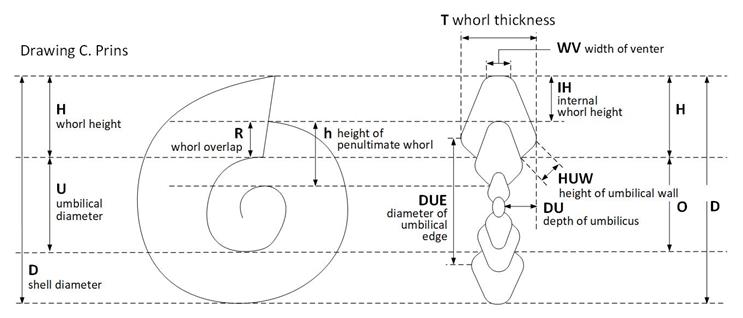
Shell measurements are shown on the left. Only D, H, T and U are frequently used. They are measured in mm to derive ratios H/D, T/D, U/D and H/T. U is evaluated between two opposite points of the umbilical seam. The whorl section is compressed si H/T > 1 and depressed otherwise. The shell is involute if whorl overlap exceeds 50% (if U/D < 0,25 for some authors), else it is evolute. Authors like Spath and Casey often give a list of measures without explanations : the order is always D, H/D, T/D and U/D. It is then possible to deduce other ratios, like T = T/D x D and H/T = (H/D)/(T/D).

Mesurements should be taken at the same diameter, as close as possible to the aperture. D is the maximum dimension of the spiral, not of a segment passing through its center. If the aperture is damaged, one may measure at a smaller diameter, indicated in brackets after D, for example 85 (63).

If ribs are thick, one can measure whorl thickness T at the ribs or between them. On this site, we use in general the first method because the ribs may be offset from one side to the other. Another useful criterion is the number of ribs, counted on the last whorl and close to venter, because short intermediate ribs can originate quite high on the flanks.

When identifying a specimen, the ratios can be used to separate species within a genus. However, they can vary depending on the growth stage and also within a population, where they follow normal distributions. Deformation during fossilization can also affect them. Therefore, they must be employed with caution, in conjunction with other criteria such as cross-section shape and ornamentation. Nevertheless, ratios are quite stable in some species, such as H/T and U/D in Sonneratia dutempleana. The whorl growth rate (H/h), although rarely used, is sometimes very discriminating: for example, Eogaudryceras numidum is easily identifiable by its high H/h, close to 2.5.

For precise and quick measurements, ideally you need a digital caliper with an extended upper jaw (also called digital caliper with offset jaw, see photo). This jaw allows you to measure height (H) without bias, with the caliper's ruler perfectly parallel to the shell's plane of symmetry. The small jaws on the right are handy for measuring the umbilical diameter. This type of caliper is not the most common in DIY stores and is rather expensive, but it will last you a lifetime! I found mine on an English website, Machine-DRO.