Created 2025/03/15
Updated 2025/10/31
Moretella sp.
| Measurements |
D mm | H/D | T/D | O/D | H/T | Ribs |
|---|
| CP-599 |
38.4 | 0.47 | 0.39 | 0.28 | 1.19 | 23 |
| CP-202 |
43 | 0.45 | 0.38 | 0.26 | 1.22 | 24 |
| CP-162 |
45 | 0.43 | 0.31 | 0.24 | 1.39 | 22 |
| CP-613 |
46.2 | 0.41 | 0.34 | 0.29 | 1.21 | 26 |
| Age |
Origin |
|---|
A. besairiei
Malagasy zne
Lower Albian
|
Ambatolafia
Boeny Region
Madagascar
|
Description.
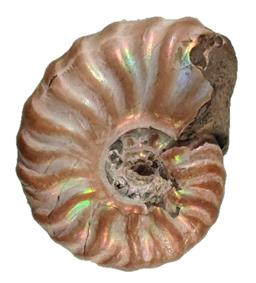
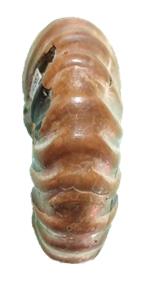
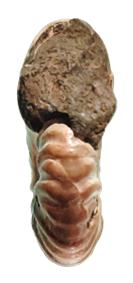
A pretty little ammonite in fine gray sandstone covered with a pearly test, apparently with its body chamber. Whorls 60% covered, with a moderately compressed elliptical cross-section. The rather wide umbilicus, sloping at 60°, passes to the flank with a rounded edge and clearly shows the inner whorls. On these whorls, long, sigmoid ribs originate low on the umbilical wall. On the last whorl, they originate slightly higher, on the umbilical shoulder. They bear a peri-umbilical tubercle, or rather a raised area without widening, which disappears on the last half-whorl to give ribs that form gradually. A shorter rib generally separates two successive long ones. In total, 24 slightly thick ribs cross the venter, where they reach their maximum strength and form a rounded sinus on the siphonal line. The strength of ribs on venter and their spacing are somewhat irregular. Sutures are invisible.
Remarks.
Our specimens are quite variable. CP-613 has bifid ribs, the others long and short ribs. CP-202 is the thickest, with the strongest, distinctly inflated ribs. The whorl section of CP-613 is broadly oval, that of CP-162 is elliptical with slightly flattened flanks, and that of the other two is really elliptical.
Their measurements fall between several Collignon's species, justifying Kennedy & Klinger (2012) who believe that the Moretella are probably conspecific (see the genus entry). This is why we label our specimen "Moretella sp."
This genus is frequently found on the internet, where it is incorrectly called Pseudosonneratia sakalava or Cleoniceras madagascariense. The former, from the basal Albian, does not exist at Ambatolafia. The second has a lanceolate whorl section and falciform ribs (see its entry).