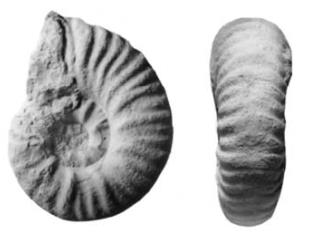
Description. Type Pseudosonneratia madagascariensis Collignon, 1949 (photo). According to Collignon (1949), Wright (1996), and Kennedy & Klinger (2012), these ammonites, whose adults are limited to 40–50 mm in diameter, are probably microconchs. Whorls are half-covered and have a round, elliptical, or sub-rectangular cross-section. Primary ribs ascend obliquely up the umbilicus wall and then bifurcate in the inner half of the flanks. They are proverse, somewhat flexuous, with shorter intercalaries here and there. The ribs are reinforced on the ventrolateral shoulders and the venter, which they traverse with a rounded, broad, and shallow sinus. On the inner whorls, the ribs have small umbilical tubercles, or more precisely, a raised area that disappears early. Suture line not published. Genus from the Lower Albian, known only from Madagascar and South Africa.
Species. In 1949, Collignon defined small Lower Albian forms from Madagascar, including three Pseudosonneratia (ambigua, balmensiformis, madagascariensis) and two Lemuroceras (moreti and transiens). In the Albian fascicle of his Atlas of Characteristic Fossils of Madagascar (1963), he moved these 5 species into his new genus Moretella and added M. subquadrata and M. undata. Kennedy & Klinger (2012) revised the genus, with better pictures of Collignon's types: where the latter saw differences, they see only dimorphism and intraspecific variation. Collignon (1949) states that M. moreti is a transition form between M. ambigua and madagascariensis: Kennedy & Klinger (2012) consider them synonyms and believe that other Moretella are probably conspecific.
This is why they name their only specimen, from South Africa, "Moretella sp.". Furthermore, they see few differences with several Pseudosonneratia not included in Moretella by Collignon, particularly P. dondey and P. ihopensis (both from Collignon, 1963), which they classify as Moretella. Even other Malagasy Pseudosonneratia such as P. sakalava Collignon, 1949, are suspect because they lack the sub-rectangular whorl section of this genus (Casey, 1965, p. 539). Finally, they emphasize the striking resemblance between Moretella and certain Lemuroceras: they could even be dimorphs. A complete revision of the Lemuroceras, Moretella, and Pseudosonneratia coexisting in the Lower Albian of Madagascar would therefore be necessary.
Remarks. The majority of Malagasy Albian ammonites come from Ambatolafia. In fossil fairs and online, most Cleoniceras madagascariense and all Pseudosonneratia sakalava are actually Moretella. The former species has an ovoid compressed whorl section and ribs with a strong ventral sinus; see its entry. The latter defines the first zone of the Malagasy Albian, not recorded in Ambatolafia according to Rakotonimanana & Rajaonarivelo (2023). Moreover, the known specimens are fragmentary and not pearly (Collignon, 1965). The stratigraphic level of genus Moretella is uncertain: Collignon cites it with Lemuroceras in the Lemuroceras spathi and Brancoceras besairiei zone, but in Ambatolafia it coexists with Aioloceras besairiei which defines an older zone, in which Lemuroceras is not yet present.
| Moretella (1) | sp. |