Created 2024/10/25
Updated 2025/11/01
Phylloceras (Goretophylloceras) subalpinum (d'Orbigny, 1841)
| Measurements |
D mm | H/D | T/D | O/D | H/T |
|---|
| RJ-8 | 27.8 | 0.59 | 0.47 | 0.07 | 1.50 |
| BM 39769 | 28 | 0.60 | 0.40 | 0.05 | 1.24 |
| 2445 Delamette* | 32.7 | 0.60 | 0.44 | 0.06 | 1.38 |
| 5797-1 d'Orbigny | 35.3 | 0.63 | 0.48 | 0.08 | 1.33 |
* Morph
ellipticum like RJ-8
| Age |
Origin |
|---|
Gault clay
H. benettianus zone
L. lyelli subzone
Middle Albian
|
Le Gaty
Géraudot
Aube, France
|
Description.
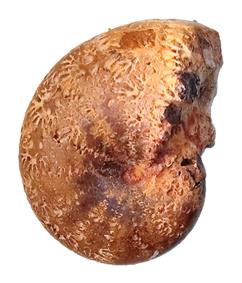
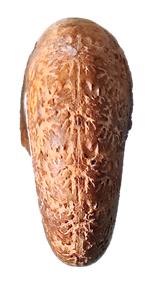
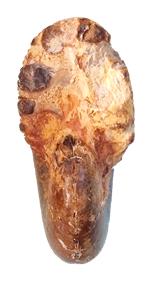
Thick and highly involute ammonite, preserved as a fully septate, pyritic internal mold. Whorls rapidly increasing in height, elliptical in cross-section, with slightly flattened flanks and maximum thickness at mid-flank. Tiny, very deep, funnel-shaped umbilicus. No notable umbilical or ventral shoulders. The surface of the internal mold is smooth and clearly exposes the suture lines. These are hollowed out by fossilization, making them tangent and therefore difficult to trace. However, under magnification, the saddles are phylloid. The main saddle (S) has two large terminal phyllites (a so-called diphyllous saddle), while the first lateral saddle (S1) is triphyllous. Furthermore, the first lateral lobe (L1) is distinctly deeper than the ventral lobe (L) (see the terminology on sutures). This is the typical septal line of the subgenus Goretophylloceras (Joly, 1998).
Remarques.
Personal discovery. A rare Tethyan species in the Aube region, defined by an ovoid cross-section and maximum thickness near the umbilicus; see the specimens of Spath (1923, test-fig. 4, p. 16) and Matrion (2010, fig. 192-C). Kossmat (1895) created G. ellipticum for a form with identical sutures, but an elliptical cross-section and maximum thickness at mid-flank. This form is kept by Joly (2000), but Wiedmann (1964) considers it a subspecies of G. subalpinum. Finally, Joly & Delamette (2008) reclassified G. ellipticum as a mere morph of G. subalpinum, because the two forms are found together and statistical analysis reveals similar proportions. Our specimen is therefore a Phylloceras (Goretophylloceras) subalpinum (d'Orbigny, 1841), morph ellipticum Kossmat, 1895!