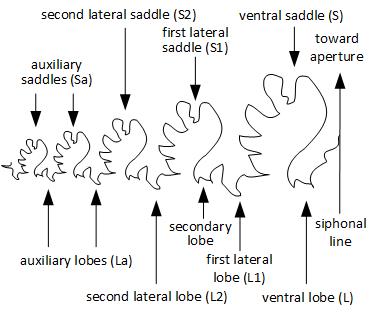
Definition. The suture, or suture line, is the line of junction of a septum with the wall of outer shell. It must not be confused with the umbilical suture, or line of involution, which is the helical line of overlap of successive whorls. The suture has great systematic value: it allows not only the distinction of genera, but also their relationships (phylogeny). However, it is only visible on the internal mold, when the test has disappeared during fossilization or has been removed. Traditionally, the suture is drawn for one side of the whorl, from the siphonal line to the umbilical suture, with the upper side toward aperture. The dorsal part exists but is rarely depicted, because it requires breaking the ammonite.
Elements. On the suture on the left, the curves directed forward (upward on the drawing) are the saddles, while the ones directed backward are the lobes (cf. the Shell description for orientation). There are several notation systems for these elements: we use the one of Saveliev (1973a). The external or ventral lobe denoted L or E has the siphonal line as axis of symmetry. By moving toward the umbilicus, we find the main or ventral saddle S, le first lateral lobe L1, the first lateral saddle S1, the second lateral lobe L2 and the second lateral saddle S2. The remaining saddles and lobes, smaller, are auxiliary elements, not to be confused with secondary lobes and saddles, that are subdivisions of elements already cited.
Reproduction. Reproducing a suture is not obvious. Nicosia et al. (1977) describe a method based on a cellulose acetate film. It is also possible to enlarge a photo of the shell on a tablet, and then to draw the suture using a stylus. In the worst case, a fine-tipped marker and a plastic film or sheet of tracing paper applied on the screen can be used. We have drawn in this way the unpublished suture of Tetrahoplites subquadratus.
