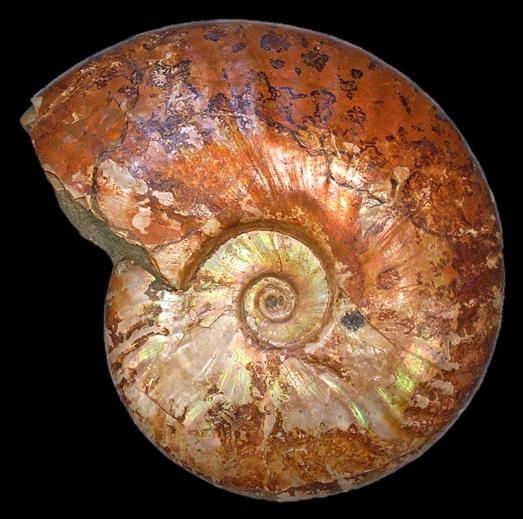
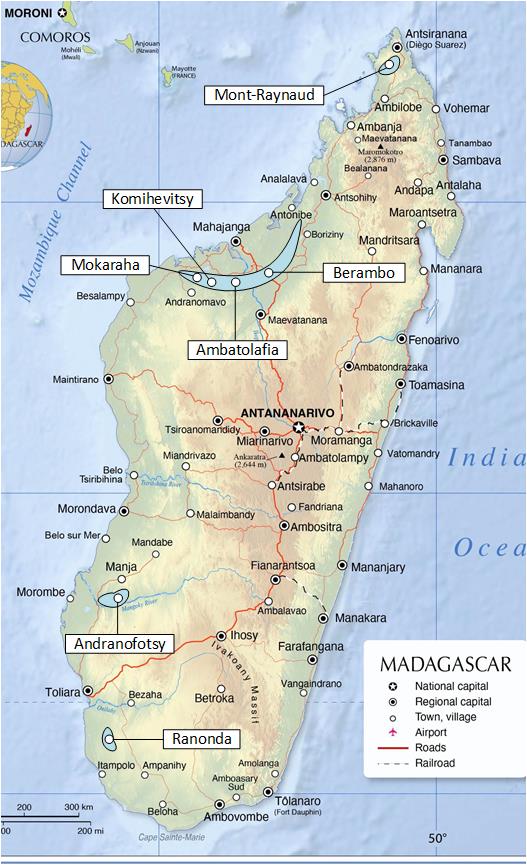
General. The Albian of Madagascar is known to the general public for its beautiful pearly ammonites, sold at mineral shows and online. The map (adapted from the Nations Online Project) on the right shows the albian outcrops (in blue) and the names of some deposits. It is noticeable that this stage is limited to the west of the island. The outcrops are numerous but discontinuous, due to basalt flows and laterite covers. The indicated origin is often the coastal city of Mahajanga (formerly Majunga), in the Boeny region, in the northeast of the island. In fact, the Albian forms an arc-shaped band, quite far from this city. It starts from the coast near Analalava, 200 km to the northeast, then extends about 100 km inland, passing east and then south of Mahajanga, before reaching almost the coast near Soalala, 100 km southwest of Mahajanga.
From west to east on this arc, the main deposits are Mokaraha, Komihevitsy (formerly Komihevitra), Marerano, Malandiandro, Befamonto, Ambarimaninga, Ampanihy, Betsikiry, Antsondrodava, Ambatolafia, Tsaramandroso, Madirovalo, Berambo and Ambanjabe. The sites from Befamonto to Ambatolafia, the richest, are on a strip of 30 km south of Mahajanga. Apart from the Boeny region, the marine Albian exists in the Antsiranana region (formerly Diego-Suarez) in the north of the island (Mont Raynaud), in the Menabe region in the west (Andranofotsy, near Manja) and in the Atsimo-Andrefana region in the southeast (Ranonda, east of Toliara, ex-Tulear).
Ammonite zones. The Albian of Madagascar was studied primarily by Collignon, in his memoirs on the deposits of Mont Raynaud (1932), Ambarimaninga (1949b), Komihevitra (1950a), Mokaraha (1950b), and Andranofotsy (1951). Besairie's book on the Northwest of the island (1936) should also be mentioned. Collignon also wrote an Atlas of Characteristic Fossils of Madagascar, the largest volume, X, of which summarizes the Albian faunas (1963). It also contains a zonation based on ammonites, reproduced in the table on the right. The original zonation placed the lyelli zone at the end of the Lower Albian; we have moved it because this ammonite indicates the beginning of the Middle Albian since Birkelund (1984). Since the country's independence, research on the Malagasy Albian has been rare: Joly (1993) on Phylloceratidae, Rakotonimanana (2006, 2016), Kiel (2006) and Rakotonimanana & Rajaonarivelo (2023) on the fauna of Ambatolafia, and Zakharov et al. (2016) on oceanic paleotemperatures.
Collignon's zonation is less precise than that of the Anglo-Paris Basin. Furthermore, it is based on zones of abundance or assemblage zones, known for their fuzzy boundaries. For example, the zone ammonite Aioloceras besairiei is still present in the following zone of Douvilleiceras inaequinodum (Collignon, 1949b). Compared to Europe, there is a gap in the basal Albian record. In addition, Leymeriella and hoplitids such as Hoplites, Anahoplites, Dimorphoplites, and Euhoplites are unknown. On the other hand, we find a genus known throughout the Indian Ocean, Lemuroceras, and another present in South Africa and Argentina, Aioloceras, which is not surprising because these last two regions were attached to Madagascar during the Albian.
Collignon was a renowned ammonitologist, but he did little work on correlations between the numerous outcrops on the island. We have added a column to the zonation table with approximate correlations to the phylogenetic zonation of the Anglo-Paris Basin (Amédro, 1992), based on Collignon's faunal lists (1963), his comparative studies with Western Europe (1965), and the zonation for South Africa (Kennedy & Klinger, 2012). The European zones in red are reliable equivalents.
Exploitation of ammonites. Since 1995, the Malagasy government has encouraged artisanal fossil mining in an effort to create jobs in one of the world's poorest countries. A law even prohibits the export of unworked pearly fossils, meaning that raw specimens are rare. Generally, the fossils are mutilated by sawing and polishing. When this isn't done, the last section of the shell is often sawn off to justify minimal human labor. Fortunately, this scientifically damaging practice has been compensated by the designation of other deposits as geological reserves.
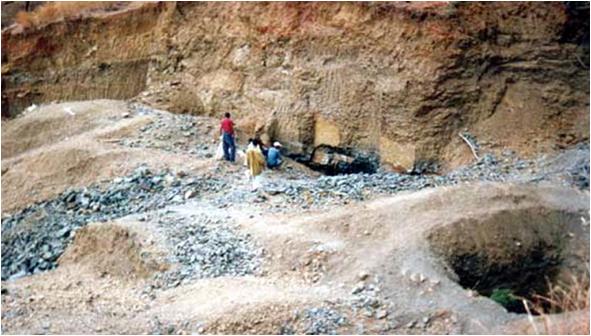
Currently, the Albian ammonites sold in shows and online almost all come from quarries worked by local residents, at the foot of a 5 km escarpment north and west of the village of Ambatolafia. This area is deteriorating, and Malagasy paleontologists are calling for urgent protection measures (Rakotonimanana, 2023b). Ammonites still included in their greenish matrix are bought from the miners by companies that handle their preparation and polishing, such as the Société d'Exportation des Ammonites de Madagascar (SEAM, Madagascar Ammonite Export Company) near Antananarivo, the capital.
The Ambatolafia quarries have been in operation since 1999. They are all located in the Lower Albian Aioloceras besairiei zone. Over the years, the number of species exported has gradually decreased: currently, the available ammonites are almost all Aioloceras besairiei and Douvilleiceras sp. The descriptions of the layers are contradictory. Rakotonimanana mentions clays with pearly pyritic fossils in his master's thesis (2006), whereas I have never seen any pyritic specimens. Kiel (2006) writes that the pearly ammonites come from a 15-20 cm thick bed of glauconitic sandstone, overlain by 15 cm of dark gray, glauconitic siltstone, which is poor in fossils.
Rakotonimanana & Rajaonarivelo (2023) recorded the following section in a miner's shaft and no longer mention pyritic fossils. Layer 0: 0.9 m of Aptian glauconitic sandstone. Layer 1: after a sedimentation gap, 3.3 m of dark gray, ferruginous siltstone, altered to brown and rich in pearly ammonites. Layer 2: 1.5 m of azoic siltstone of deltaic origin. Layer 3: 1.6 m of gray, ferruginous siltstone, altered to yellow, again with pearly ammonites. For my part, I can say that my specimens are in an indurated, gray to gray-green siltstone, without visible grains under magnification except for occasional large glauconite spots. I also have Aconeceras from the underlying Aptian sandstone (bed 0), but from Befamonto, 20 km from Ambatolafia. Their matrix has an identical appearance.
Frequent mistakes about Malagasy ammonites. Except for very old specimens, provenances other than Ambatolafia are rarely accurate. We see vague origins such as Mahajanga, the large city 100 km north of the deposits. Some names taken from Collignon's Atlas predate independence and the Malagasy language change, such as Majunga, Tuléar, or Diego-Suarez, called today Mahajanga, Toliara and Antsiranana. Provenances for ammonites from the Aioloceras besairiei zone are downright false, such as Ambarimaninga: in fact, this deposit is in the Lemuroceras spathi and Brancoceras besairiei zone (Collignon, 1949), with ammonites that I have never seen for sale. More generally, one does not see ammonites from the Middle or Upper Albian in the trade.
We now list common identification errors found on the web. Except for Cleoniceras madagascariense, ammonites sold as Grycia or Cleoniceras are actually Aioloceras, following the revision by Riccardi and Medina (2002). Grycia is an Arctic genus from Alaska and Svalbard. Both genera are compressed, involute, with a high ogival cross-section and falcate ribs, but Cleoniceras has umbilical tubercles, whereas in Aioloceras the ribs arise gradually.
The genus Moretella is common in Ambatolafia and occasionally appears on online sales sites, but so far I have never seen a properly labeled specimen. These small ammonites, at most 5 cm in diameter (see our Genera entry), are sold as Cleoniceras madagascariense or Pseudosonneratia sakalava. In fact, the former has umbilical bullae (at least an abrupt emergence of the ribs) and a lanceolate cross-section. The latter defines the first zone of the Malagasy Albian but is known only from fragmentary and non-nacreous specimens (Collignon, 1963). Furthermore, it is unknown in Ambatolafia.
Beudanticeras ambanjabense and B. revoili specimen are sold as Aioloceras and vice versa. Both genera are compressed, with a narrow venter and a small umbilicus with a subvertical wall. However, the two Beudanticeras are smooth in juveniles and then develop fine, widely spaced ribs on the test, corresponding to thin grooves on the internal mold. Aioloceras, on the other hand, are covered with ribs, even if they are attenuated and/or irregular at a large diameter. The true B. ambanjabense, which I have never seen for sale, is distinguished from revoili by intersecting sutures and a higher number of ribs: 12-14 per whorl instead of 9-10 (Collignon, 1963).
List of the 28 Malagasy Albian ammonites of this site
- Aioloceras besairiei young macroconch
- Aioloceras besairiei adult macroconch
- Aioloceras morganiforme
- Aioloceras tenuicostulatum
- Argonauticeras besairiei
- Beudanticeras komihevitraense
- Beudanticeras revoili
- Cleoniceras (Cleoniceras) madagascariense
- Desmoceras latidorsatum sensu stricto
- Desmoceras latidorsatum var. inflatum
- Desmoceras latidorsatum var medium
- Douvilleiceras inaequinodum strongly ribbed
- Douvilleiceras mammillatum clavatus stage
- Douvilleiceras mammillatum moniliform stage
- Douvilleiceras mammillatum adult
- Eodouvilleiceras aff. pedrocarvajali
- Eogaudryceras (Eogaudryceras) numidum var. malandiandrensis
- Eogaudryceras (Eotetragonites) umbilicostriatus
- Melchiorites falcistriatus var. mitsinjensis
- Moretella sp.
- Neosilesites maximus
- Neosilesites nepos
- Phylloceras (Hypophylloceras) velledae
- Phylloceras (Goretophylloceras) inflatum
- Puzosia (Puzosia) provincialis
- Puzosia (Anapuzosia) saintoursi
- Trochleiceras balearense
- Umsinenoceras linguatuberculatum
| Albian | Malagasy zone | Sites | European zone |
|---|---|---|---|
| Upper | Neophlycticeras madagascariense |
Antsiranana Betaitra |
M. perinflatum M. rostratum |
| Mortoniceras inflatum | Mont Raynaud Andranofotsy II Mokaraha II Maniamba-Amba Manamana Ampakabo-Aontzy Vohimaranitra |
M. fallax M. inflatum | |
| Hysteroceras binum | Mont Raynaud | M. pricei | |
| Dipoloceras cristatum | Andranofotsy I | D. cristatum | |
| Miidle | Oxytropidoceras acutocarinatum Manuaniceras jacobi |
Androiavy Berambo sup. Mokaraha I Marerano |
D. biplicatus D. niobe A. intermedius H. (H.) dentatus |
| Lyelliceras lyelli | Komihevitra | H. (H.) benettianus | |
| Lower | Lemuroceras spathi Brancoceras besairiei |
Berambo inf. Ambarimaninga Ampanihy Nord Ampanihy 4 km W. Ampanihy Ballon Loza |
H. (I.) steinmanni |
| Douvilleiceras inaequinodum |
Befamonty Malandiandro Ambanjabe III Besavatra |
O. subhilli | |
| Aioloceras besairiei | Ambatolafia I Ambatolafia II |
P. (H.) puzosianus C. floridum | |
| Pseudosonneratia sakalava | Manosibohitra | S. kitchini |
Bluish blocks are the fossiliferous glauconitic sandstone