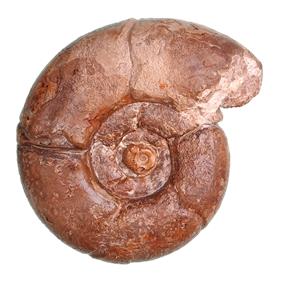
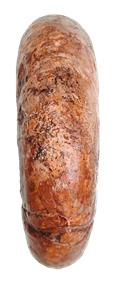
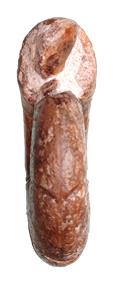
Puzosia (Puzosia) mayoriana (d'Orbigny, 1841)
| Measurements |
D mm | H/D | T/D | O/D | H/T |
|---|
| SM B35523* |
80.5 | 0.38 | 0.34 | 0.33 | 1.12 |
| 6112 d'Orbigny |
84 | 0.35 | 0.34 | 0.33 | 1.04 |
| CP-287 |
93.9 | 0.35 | 0.33 | 0.39 | 1.06 |
* Wright & Kennedy (1984)
| Age |
Origin |
|---|
Base of Pénzeskút Marls
Upper Albian
Level condensing the
M. fallax & M. perinflatum zones
|
Tilos Forest
Pénzesgyõr
Bakony Mountains
Hungary
|
Description.
Flat internal mold in white limestone with a brown coating. Whorls with a 40% overlap, gradually increasing in height. Inverted U-shaped whorl section, barely compressed, with nearly flat sides, slightly converging towards a broad, rounded venter, without well-defined shoulders. The wide, low-walled, stepped umbilicus contains a very small ammonite.
The last whorl has six narrow but deep constrictions originating at the umbilical seam. The first three are sigmoid, shaped like a broken line with three segments. On the ventral side, they form an angular chevron of 110° and are almost completely filled just over the siphonal line. The last three constrictions have a more rounded shape on the flanks and venter, with a chevron of 130° preceded by a ridge limited to ventrolateral shoulders and venter. Under grazing light, about twenty ribs can be seen between the last two constrictions, limited to the upper half of the flanks and forming a broad, rounded ventral sinus.
Remarks.
So-called Puzosia planulata (J. de C. Sowerby, 1827) from the same Hungarian site can be found online, but Szives et al. (2007) only cite P. mayoriana. In fact, the second name was proposed by d'Orbigny (1841) to replace the first, which was a homonym of Ammonites planulatus Schlotheim, 1820, a species of a different genus. Wright & Kennedy (1984) validated this proposal. Although the name P. planulata should no longer be used, it remains employed by some authors, such as Wright (1996). P. mayoriana and its synonyms were reviewed by Wright & Kennedy (1984) and then by Kennedy & Klinger (2014).
Following the revision by Wiedmann and Dieni (see the genus entry), the species is restricted to forms with a broad umbilicus, 4 to 6 sinuous constrictions, ventral sinuses that are usually angular, and a whorl section that is only slightly compressed, with subparallel flanks and a broadly rounded venter. It is a cosmopolitan ammonite found from Late Albian to Late Cenomanian.