Created 2025/10/16
Updated 2025/11/01
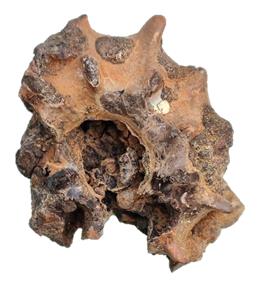
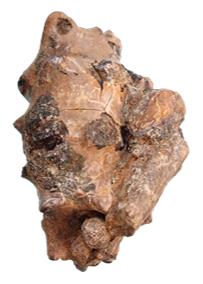
Protohoplites (Protohoplites) archiacianus (d'Orbigny, 1841)
| Measurements |
D mm | H/D | T/D | O/D | H/T |
|---|
| CP-542 |
78 | 0.44 | 0.49 | 0.31 | 0.89 |
| BM C12178 Casey 1965 |
65 | 0.40 | 0.48 | 0.30 | 0.83 |
| Lectotype* |
104 | 0.42 | 0.45 | 0.30 | 0.93 |
| École des Mines n° 976 |
112 (85) | 0.44 | 0.54 | 0.25 | 0.81 |
* The largest of the two specimens figured by d'Orbigny (1841)
| Age |
Origin |
|---|
Phosphatic nodules, condensed level
S. kitchini to P.(H.) puzosianus zones
Lower Albian
|
Machéroménil
Ardennes
France
|
Description.
A reworked ammonite with a brown shell, which cannot be extracted from its fragile, black phosphate nodule. The internal whorls and the second quarter of the last whorl are missing. Whorls 70% covered, with a slightly depressed hexagonal cross-section. Umbilicus fairly wide with an almost straight wall, sloping at 60°, and a broadly rounded margin towards the flank. On the last half-whorl, there are six slightly proverse, radially pinched, triangular umbilical bullae and seven raised ventrolateral spatulae, forming an angle of 70-80° with the siphonal line. These spatulae are opposite on either side of the siphon and connected by a low bridge. They are broken, except for the one at the upper left in the ventral view. The intercostal spaces are harmoniously concave. Each umbilical bulla is connected to two successive spatulae by two low, sometimes indistinct ribs.
Remarks.
A rare ammonite from the puzosianus zone, illustrated by d'Orbigny (1841) and Casey (1965, p. 481). Known from southeast England (Folkestone) and the Ardennes (Macheroménil), I also saw a quarter of whorl from Raveuse in Yonne (no. 69-990) at the Auxerre Museum. CP-542 has particularly strong tubercles. Compared to Protohoplites (Hemisonneratia) puzosianus, the rib collapse is almost complete along the siphonal line, the ventrolateral tubercles are much more prominent, and the ribs are weaker. A related species is Protohoplites (Protohoplites) michelinianus (d'Orbigny, 1841), compressed with smaller, conical tubercles (see its entry). According to Matrion et al. (2000), it could be the same species with a wide range of variation.