Prolyelliceras ulrichi (Knechtel, 1947)
| Measurements |
D mm | H/D | T/D | O/D | H/T |
|---|
| CP-668 |
96.5 | 0.27 | 0.28 | 0.50 | 0.96 |
| Holotype1 |
107 | 0.30 | 0.28 | 0.47 | 1.06 |
1 Measured on the photo in Knechtel
et al. (1947).
| Age |
Origin |
|---|
Pariatambo Formation
ulrichi Peruvian zone
Beginning of Middle Albian
|
Pongo de Rentema
Bagua Province
Ancash Region, Peru
|
Description.
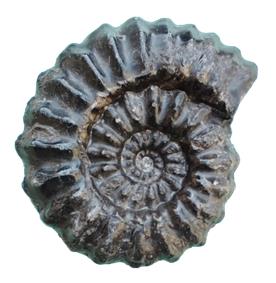
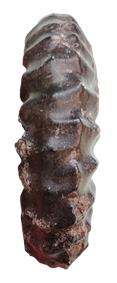
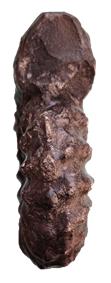
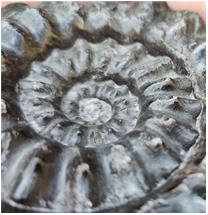
A very evoluted internal mold in black shale of an adult individual, with no visible sutures. The body chamber on the last half-whorl contracts and tends to uncoil, covering only 10% of the previous whorl at the end. The whorl section is subquadrate with truncated upper corners. The umbilicus has a fairly low wall and is quarter-circle in shape. 22 strong, radial, and widely spaced ribs originate from its edge and cross the flank then the venter. Each rib bears a siphonal and a ventrolateral clavus, both slightly elongated. A small, protruding lateral pimple is also present. It is clearly visible at mid-flank, even on the innermost whorls (photo on the right), then gradually moves to the outer third of the flanks on last whorl. The umbilical suture is wavy because it rests on the ventrolateral clavi of the previous whorl.
Remarks.
This specimen is malformed, or deformed by fossilization: the outer row of clavi is shifted laterally relative to the siphon, to the right on the ventral view.
Created as a Lyelliceras by Knechtel, this ammonite defines the first zone of the Peruvian Middle Albian, where it is quite abundant, following the P. mathewsi zone that marks the end of Lower Albian (Robert, 2002). It is distinguished from the latter (see its entry) by a less compressed whorl cross-section and lateral tubercles that appear very early. It is the most common black ammonite from Peru found on the internet and at fossil shows, along with Eubrancoceras aegoceratoides (see its entry).