| Measurements | D mm | H/D | T/D | O/D | H/T |
|---|---|---|---|---|---|
| RJ-1392 | 19.3 | 0.42 | 0.36 | 0.28 | 1.17 |
| CP-91 | 31.1 | 0.39 | 0.34 | 0.33 | 1.37 |
| Age | Origin |
|---|---|
|
Grey clay, lyelli subzone benettianus zone Middle Albian |
Brévonnes Aube France |
| Measurements | D mm | H/D | T/D | O/D | H/T |
|---|---|---|---|---|---|
| RJ-1392 | 19.3 | 0.42 | 0.36 | 0.28 | 1.17 |
| CP-91 | 31.1 | 0.39 | 0.34 | 0.33 | 1.37 |
| Age | Origin |
|---|---|
|
Grey clay, lyelli subzone benettianus zone Middle Albian |
Brévonnes Aube France |
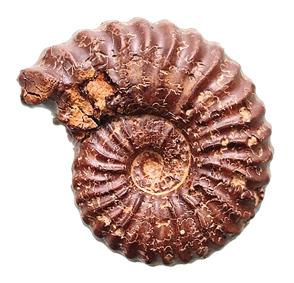
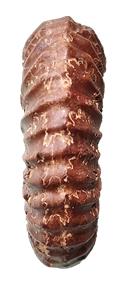
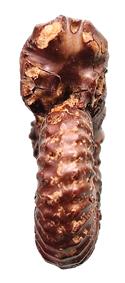
Description. Pyritic phragmocone with a compressed elliptical section and flattened flanks. The whorls overlap by 25%, less at the end of the spiral as the section decreases in height on the inner side. Umbilicus with a rather low wall, sloping at 60°, rounded towards the flank. 30 simple, thin ribs with wide interspaces, somewhat sigmoid, cross the slightly fastigiate venter in a broad, obtuse chevron. Most originate on the umbilical wall, but some are shorter or bifid. All are similar on venter and bear small, slightly elongated, clavate tubercles: one siphonal and, on each flank, one close ventrolateral. Suture line only slightly divided. Saddles rounded, as high as wide, with a small median incision. Lobes narrower. L1 and L2 rectangular, twice as high as they are wide, terminating in three points. L1 is deeper than L. Three auxiliary saddles are noted, the last one cut by the umbilical suture. The ventral lobes are offset from the siphon: malformation or deformation?
Discussion. Personal discovery of a rare form in the Albian of Aube! The smaller specimen RJ-1392 shows that the tuberculation appears at around 10 mm in diameter. Before this stage, the ammonite resembles a Brancoceras. In the literature, similar ammonites resembling Lyelliceras but with only 3 tubercles per flank are Prolyelliceras cotteri, P. gevreyi, and P. lobatum.
In 1930, Spath created Lyelliceras cotteri, which accompanies L. lyelli in the Middle Albian of the Hazara district in British India (now the Abbottabad district in Pakistan). He provided neither a diagnosis, nor measurements, nor a suture, but illustrated two half-turns of 26 and 20 mm (pl. 9, fig. 1 and 8, sizes deduced from the figures). A note concerns fig. 1: "The regularly trituberculate peripheral ribs are more prominent than those of L. lyelli and the whorl-thickness is only 30% of the diameter." The profile photographs show 20 and 16 thin, slightly flexuous ribs, hence 40 and 32 ribs per whorl, compared to about twenty for L. lyelli and pseudolyelli. Only ventro-lateral tubercles are visible, and only on the 26 mm holotype.
Since it is customary to count the tubercles on only one flank, including the siphonal tubercle, Spath's note was interpreted by Riedel (1938), Destombes (1979), and Robert (2002) as ribs bearing on each flank a siphonal, a ventrolateral, and a lateral tubercle. However, the description of Lyelliceras pseudolyelli in "A monograph of the ammonoidea of the Gault" (Spath, 1931, p. 320) contains a sentence that went unnoticed: "L. cotteri is more finely and closely ribbed, and is closer to L. gevreyi Jacob than to the present species." But L. gevreyi does not have a lateral tubercle; see below.
Riedel (1938, p. 56 and figs. 1, 2) describes a Lyelliceras cf. cotteri from the Middle Albian of Colombia. It is a quarter of whorl with H = 31 mm and E = 22 mm. The section is compressed, with flattened flanks. There are 10 thin, radial, and straight ribs, spaced almost twice as wide. Riedel describes indistinct tubercles at the inner 1/3 of the flanks, elongated along the rib, others in pimple form at 2/3, plus 3 rows of clavi on venter (therefore four tubercles per flank). Figure 1, in profile, clearly shows the rows of tubercles, except for the innermost ones. Riedel's identification is only affine, as he writes: "it is not possible to compare the suture lines and the ornamentation of the flanks of L. cotteri is not clear from the data provided by Spath".
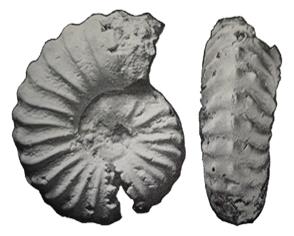
Destombes, in Rat (1979), illustrates a 60 mm Lyelliceras aff. cotteri from Courcelles (Aube). He describes ribs with a siphonal, a ventrolateral, and a lateral tubercle. In his photographs (pl. 4-24, fig. 1a-b, reproduced on the right), 25 simple, slightly sigmoid ribs, curved forward at the top of the flanks, are visible, some shorter than others. However, only the siphonal and ventrolateral tubercles are distinguishable on these photos, making this specimen ultimately very similar to our CP-91, but with slightly fewer ribs. According to Destombes, the species is associated with Lyelliceras lyelli, and there are transitional forms to Lyelliceras gevreyi, which lacks a lateral tubercle (see below). Some individuals can also be compared to Lyelliceras mathewsi Knechtel.
In his thesis on the Albian of Peru (2002), Robert follows Etayo-Serna (1979): the latter places only those forms with two tubercles per flank (siphonal and ventrolateral) in the genus Prolyelliceras and moves the forms with an additional lateral tubercle to a new genus, Ralphimlayites. In comparison, Lyelliceras has in addition one peri-umbilical tubercle, hence four tubercles per flank. Robert therefore places the Spath species in Ralphimlayites because he observes lateral tubercles, and describes Peruvian Ralphimlayites cf. cotteri. All found in fragmentary form, they have about forty simple, straight, radial or slightly proverse ribs per whorl, with the two ventrolateral rows of clavi very close to the siphonal row. They are found in the Peruvian ammonite zone equivalent to the lyelli zone of the Anglo-Paris Basin, as in Aube, but also in the zone equivalent to our pseudolyelli zone.
Since lateral tubercles may only be present at certain growth stages, Kennedy & Klinger (2008a) consider the genus Ralphimlayites to be synonymous with Prolyelliceras. On page 71, they specify that Prolyelliceras cotteri possesses "a single row of ventrolateral tubercles in addition to the siphonal." I contacted Jim Kennedy by email on November 2, 2024, who confirmed that Spath's "trituberculate peripheral ribs" mean three tubercles in ventral view, therefore one siphonal and one ventrolateral on each flank, and that Prolyelliceras cotteri has neither a lateral nor an umbilical tubercle! The ammonites of Riedel, Destombes, and Robert therefore belong to other species.
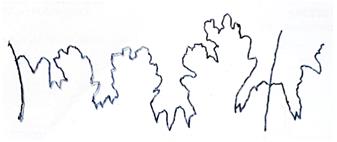
Latil, Robert, and Bulot (2009) revised Prolyelliceras gevreyi (Jacob, 1907), of which P. flandrini (Dubourdieu, 1953) is a thick variant. The species was considered Tethyan (southeastern France, Algeria, Tunisia), but Latil et al. found it in Colombian, Peruvian, and Venezuelan collections. Like P. cotteri, the ribs have only one siphonal and one ventrolateral tubercle on each flank. Breistroffer in Besairie (1936, p. 163) writes that the ribs of P. cotteri are much more closely spaced than in P. gevreyi and do not all reach the umbilical border. The suture of P. gevreyi (Latil et al., 2009, p. 341, fig. 2-n) shows a single, small auxiliary saddle. That of CP-91, shown here, is very similar but has two small auxiliary saddles. That of P. ulrichi (Knechtel, 1947, fig. 5, p. 100), is also very similar but has three small auxiliary saddles. In all three species, the last auxiliary saddle is cut by the umbilical suture. The numerous P. gevreyi shown by Latil et al. are highly variable, with 16–28 ribs, vs 30–40 for the P. cotteri of Spath. The stronger ribs with prominent ventrolateral clavi give them a rather rectangular section. But their specimen from Prés de Rencurel in Isère (fig. 3, g-h-i), with 26 lower ribs, is quite similar to CP-91.
Owen (1971) claims to have found P. gevreyi in the lyelli subzone of Courcelles, but this has never been confirmed. His specimen is probably a P. cotteri, as P. gevreyi is unknown in the Middle Albian. Indeed, in southeastern France, excluding condensed levels, P. gevreyi is only known from the Paquier level of Drôme, in the tardefurcata zone of early Albian (Bert, 2012). Latil et al. (2009) and Latil (2011) collected it in non-condensed levels in Tunisia, from the tardefurcata zone to the floridum zone (Lower Albian).
P. lobatum (Riedel, 1938, p. 57-59 and figs. 9-11) is a poorly known species from the Middle Albian of Colombia and Peru. Riedel emphasizes its proximity to P. gevreyi and P. cotteri. The Colombian holotype is 160 mm in diameter, with H/D = 0.37, T/D = 0.24, O/D = 0.36, H/T = 1.54. The 34 slightly sigmoid ribs and the somewhat elongated clavate tubercles are those of CP-91, but the ammonite is more compressed and the well-elliptical section lacks the flattened flanks of our individual. However, these differences come maybe from the large size of the specimen: the aspect of juveniles is unknown.
In conclusion, P. cotteri is a rare species from the lyelli zone, poorly defined by Spath and misinterpreted by many authors after him. The specimens from Riedel, Destombes, and Robert belong to other species since they have lateral tubercles according to these authors, even though these are not visible on the photographs. However, the possibility of a single species with inconstant lateral tubercles cannot be excluded. The only specimens illustrated in the literature are ultimately those from Spath, and the species has not been revised since. To clarify the status of this species, the holotype stored at the Geological Survey of India (no. 14508) would need to be located, better figured, and described precisely. CP-91 comes from the lyelli zone, which a priori excludes the older P. gevreyi, despite strong similarities. P. lobatum is of a compatible age, but it is known only from one large Peruvian specimen: the appearance of juveniles is unknown.