Created 2025/09/11
Updated 2025/09/21
Oxytropidoceras (Manuaniceras) powelli Young, 1966
| Measurements |
D mm | H/D | T/D | O/D | H/T |
|---|
| CP-696 |
353 | 0.44 | 0.20 | 0.29 | 2.18 |
| Holotype* |
120 | 0.39 | 0.21 | 0.29 | 1.88 |
| UT 14823* |
175 | 0.37 | 0.21 | 0.35 | 1.71 |
* Dimensions given by Young (1966)
| Age |
Origin |
|---|
Grey limestone w/marly beds
Goodland Formation
Manuaniceras powelli zone
Beginning of Upper Albian
|
Jerry Askey Farm
Decatur, Wise County
North Texas, USA
|
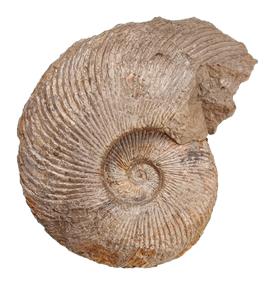
Description.
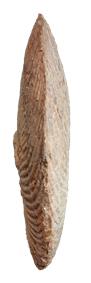
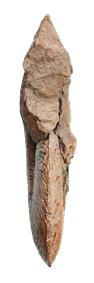
A huge, discoidal internal mold in gray limestone, 35 cm in diameter and weighing 7.1 kg, with no visible sutures. The whorls, 40% covered, have a highly compressed lanceolate section, thickest at the inner third, without ventrolateral shoulders, and with a poorly preserved (chipped) smooth keel. The umbilicus has a low wall, sloping at 70% on the inner whorls, becoming subvertical at the beginning of last whorl, and even slightly undercut at the end. The ornamentation consists of 86 proverse, flat ribs, without tubercles, almost all simple, with a low rectangular section and very narrow intervals. They originate on the umbilical wall and show rare bifurcations on the umbilical shoulder. They are straight and gradually widen in the lower two-thirds of the flanks. Then they curve regularly and thin to finish strongly projected forward at the base of the keel. On the last whorl, the ribs tend to round off, then their front slope becomes a little steeper than the rear, with wider intervals.
Remarks.
CP-696 is clearly larger than Young's specimens and those visible online. The species has three growth stages: 1) flat ribs with very fine intervals, 2) rounded ribs, and 3) stronger ribs with a steeper anterior side. Simultaneously, the intercostal spaces increase but remain narrower than the ribs. In comparison, O. (M.) moorei (see its entry) has stronger ribs, an absent or fleeting second stage, and a third stage with sigmoid ribs but less projected forward. O. (M.) powelli defines the first Upper Albian zone of North Texas (Goodland Formation), corresponding to the cristatum zone in Western Europe. Bulot et al. (2005) report it in Ecuador, where it indicates the base of Lower Albian when Dipoloceras is absent. Some Adkinsites (another subgenus of Oxytropidoceras) have similar ribs but with umbilical bullae, at least on young whorls. They are found in the Kiamichi Clay Formation, which overlies the Goodland Formation.