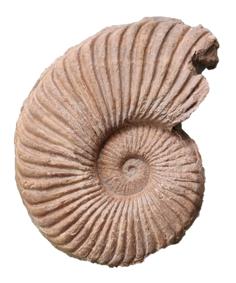
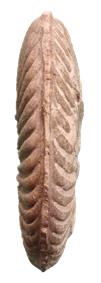
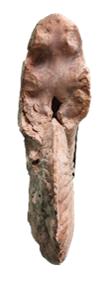
Oxytropidoceras (Manuaniceras) moorei Young, 1966
| Measurements |
D mm | H/D | T/D | O/D | H/T |
|---|
| CP-698 |
185 | 0.42 | 0.26 | 0.29 | 1.60 |
| Holotype |
210 (150) | 0.40 | 0.26 | 0.30 | 1.56 |
| Age |
Origin |
|---|
Grey limestone w/marly beds
Goodland Formation
Manuaniceras powelli zone
Beginning of Upper Albian
|
Mustang Creek
South of Benbrook Lake
Fort Worth, Tarrant County
North Texas, USA
|
Description.
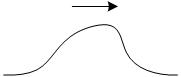
Septate internal mold in gray limestone, without visible sutures. Whorls 20% covered, growing very rapidly (H/h = 2.27). High trapezoidal section with slightly convex flanks, converging to a fastigiate venter with smooth siphonal keel. Umbilicus with low, subvertical wall and rounded edge. The ribs in the umbilicus are radial, straight or slightly convex, flat, closely spaced, without tubercles. On the last whorl, they take the shape of an integral. They originate proversely on the umbilical edge, which they cut into, then straighten, thicken toward venter, curve forward, and sag against the keel. Their section has a convex posterior slope and a steeper, slightly concave anterior one (drawing). The interspaces widen but remain narrower than the ribs. Due to an optical illusion, the ribs and interspaces look inverted on the last quarter of whorl. There are 48 ribs on last whorl, all simple.
Remarks.
Young (1966) defined the genus Manuaniceras with few whorls, a high whorl section, and a stage with numerous flat ribs, simple or bifurcating at varying heights on the flanks. Cooper (1982) and Wright (1996) consider it a synonym of Oxytropidoceras, because the type of M. manuanense (Spath, 1921) lacks flat ribs. However, Kennedy & Klinger (2011) show a second fragment (a half-whorl) of the holotype, forgotten by Spath, which does indeed has flat ribs. Hence, they reinstate Manuaniceras, but as a subgenus of Oxytropidoceras. M. moorei, endemic to Texas, accompanies the zone ammonite M. powelli in the Goodland Formation, whose age is equivalent to our cristatum zone. It has a stage with flat, slightly curved ribs, progressing to about fifty rounded, sigmoid ribs. With age, the umbilicus opens and the section becomes less compressed. CP-698 has proportions very close to Young's holotype and closely resembles his specimen in pl. 5, fig. 1-3.