Created 2024/10/23
Updated 2025/05/24
Epihoplites (Metaclavites) trifidus Spath, 1923
| Measurements |
D mm | H/D | T/D | O/D | H/T |
|---|
| Holotype |
33 | 0.43 | 0.43 | 0.30 | 1.00 |
| RJ-1649 |
54.4 (52.2) | 0.38 | 0.38 | 0.36 | 1.01 |
| LFS 1892 |
55 | 0.44 | 0.42 | 0.30 | 1.05 |
| Age |
Origin |
|---|
Phosphatic level P5
cristatum zone
Base of Upper Albian
|
Wissant
Pas-de-Calais
France
|
Description.
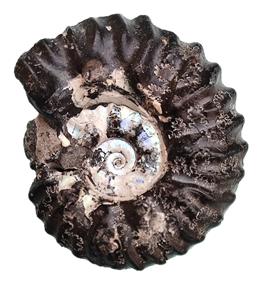
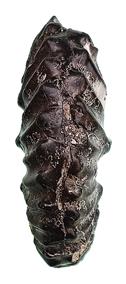
Black phosphate ammonite with remnants of a pearly test. The venter is chipped at the beginning of last whorl, and along the last 60° which correspond to the beginning of the body chamber. The whorls overlap by 50%, with a tendency to uncoil towards the aperture. The wide umbilicus clearly shows the inner whorls. Its quarter-circle wall, which rounds towards the flank, elongates and becomes progressively less steep.
The whorl section is hexagonal, as tall as wide, with slightly convex flanks and a barely concave venter. Ten umbilical bullae of increasing strength give rise to pairs of sigmoid ribs, more or less folded forward in the outer half of the flanks. An intercalary rib separates two successive pairs. At the beginning of last whorl, the ribs are cut by the flat venter. They then extend slightly beyond the ventral surface to form small clavi parallel to the siphon. There are a total of 31 ribs on the last whorl.
The well-exposed sutures show a deep, broad, trifid, and asymmetrical first lateral lobe L1. The ventral lobe L is offset from the siphon, and only its right half is still on venter, a phenomenon also known in some late Anahoplites.
Remarks.
According to Spath, the genus has bundles of three ribs, but one rib often detaches from its umbilical bulla: a better criterion is therefore to have approximately three times as many ventrolateral tubercles (or rib terminations) as umbilical ones. This species is considered by Amédro (1992) to be a thicker variant with stronger umbilical bullae of Epihoplites (Metaclavites) compressus (see its entry). Compared to published specimens (see table), the larger opening of the umbilicus in our specimen is explained by the tendency of the body chamber to uncoil.