Created 2024/10/15
Updated 2025/10/06
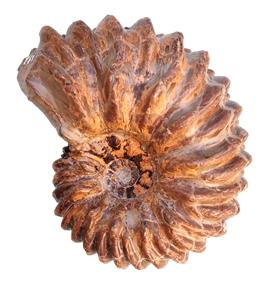
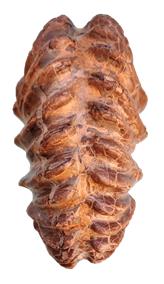
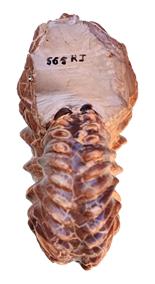
Hoplites (Hoplites) spathi – Third specimen
| Measurements |
D mm | H/D | T/D | O/D | H/T |
|---|
| CP-707 | 76.8 | 0.48 | 0.48 | 0.24 | 1.00 |
| RJ-565 | 91.1 | 0.45 | 0.49 | 0.25 | 0.92 |
| CP-257 | 139.5 | 0.45 | 0.44 | 0.28 | 1.02 |
| Age |
Origin |
|---|
Dark grey clay, bed C,
dentatus zone, Middle Albian
|
Brévonnes
Aube, France
|
| Var. | dentatus | spathi | paronai |
|---|
| H/T | 1.21-1.27 | 0.92-1.02 | 0.67-0.83 |
| T/D | 0.37-0.40 | 0.49 | 0.52-0.70 |
Description.
First, read the entry for Hoplites (Hoplites) dentatus. The famous Courcelles B bed (H. benettianus zone) extends northeast into the Aube department and outcrops again in Temple Lake (aka Aube reservoir) at Brévonnes, and at the Aube riverbed in Dienville. This specimen was found at Brévonnes, 30 cm above bed B, that is, at the base of bed C which is entirely in the H. dentatus zone. Like most ammonites from this layer, the nucleus is preserved in pyrite. Here, it is followed by the body chamber, made of gray limestone covered with a brown shell, which occupies the last whorl. The relatively wide ventral groove and the H/T ratio correspond to the medium-thickness variant spathi of Hoplites dentatus. The ammonite is younger than CP-257. Its ribs are more prominent, particularly the umbilical bullae and ventral terminations. On the last half-whorl, the umbilical bullae move almost to the middle of the flanks, giving a nearly hexagonal whorl section. There are 12 umbilical bullae and 29 ribs near venter.