Created 2023/04/21
Updated 2024/10/12
Hoplites (Hoplites) benettianus (J. de C. Sowerby, 1826)
| Measurements |
D mm | H/D | T/D | O/D | H/T |
|---|
| Jaffré 2007 p.67 | 88.2 | 0.43 | 0.69 | 0.30 | 0.63 |
| Lectotype Spath 1925 | 110 | 0.42 | 0.64 | 0.30 | 0.66 |
| CP-625 | 223 | 0.32 | 0.38 | 0.38 | 0.86 |
| Age |
Origin |
|---|
Sables de Frécambault, benettianus zone
lyelli subzone, beginning of Middle Albian
|
Yonne
France
|
| Var. | devisensis | pseudodeluci | baylei
| benettianus | bullatus |
|---|
| H/T | 1.27-1.37 | 0.90-1.08 | 0.76-0.80 | 0.64-0.66 | 0.55-0.59 |
| T/D | 0.32-0.37 | 0.39-0.46 | 0.53-0.54 | 0.63-0.69 | 0.66-0.73 |
Description.
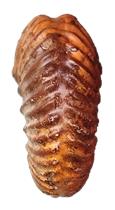
Large senile specimen with a preserved test and its body chamber on the last half-turn. The chamber no longer increases in height, contracts in thickness, and tends to uncoil. 11 primary ribs end in a big umbilical bulla, bifurcating in two curved forward secondary ribs.
With growth, these bullae become more spaced, move to mid-flank, and become more prominent. In parallel, the secondary ribs become straight and their bifurcation angle increases. Finally, the bullae collapse. Including a few intercalary ribs, there are 32 ribs on the flattened venter. Their terminations form a 70-80° angle with the siphon and alternate on either side of it. However, they are very shallow and do not delimit a distinct groove.
Remarks.
Personal discovery. The last table lists the variants of H. benettianus, based on measurements of specimens from Spath (1925). Just before the contracted body chamber, the H/T ratio of CP-625 is 0.65, which corresponds to the benettianus sensu stricto variant. H. benettianus and dentatus are difficult to distinguish in the senile stage, as both converge toward this moderately thick form, lacking a ventral groove (Courville & Lebrun, 2010). This convergence is also known in the Sonneratia, where S. grandis Sinzow, 1907 is thought to be the senile form common to several species (Destombes in Rat, 1979).
The image on the right shows the typical venter of a small pyritic benettianus of 28 mm. The low, close ribs stop at the siphonal line, defining a narrow ventral groove with a V-shaped section. They are even slightly interlocked in the lower part of the picture, which makes the groove somewhat sinuous.

