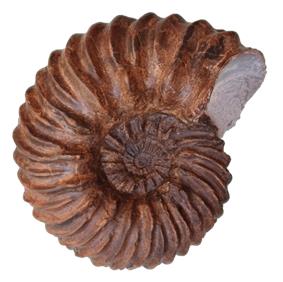
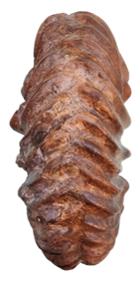
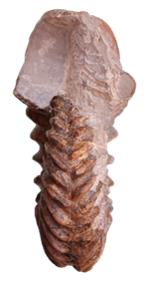
Hoplites (Hoplites) pseudodeluci – Other spécimen
| Measurements |
D mm | H/D | T/D | O/D | H/T |
|---|
| Spath 1925 | 34 | 0.46 | 0.46 | 0.24 | 1.00 |
| CP-623 | 165 | 0.41 | 0.37 | 0.32 | 1.08 |
| CP-687 | 193 | 0.38 | 0.45 | 0.32 | 0.85 |
| Age |
Origin |
|---|
Bed B, benettianus zone
lyelli subzone, Middle Albian
|
Courcelles, Clérey
Aube, France
|
| Var. | devisensis | pseudodeluci | baylei
| benettianus | bullatus |
|---|
| H/T | 1.27-1.37 | 0.90-1.08 | 0.76-0.80 | 0.64-0.66 | 0.55-0.59 |
| T/D | 0.32-0.37 | 0.39-0.46 | 0.53-0.54 | 0.63-0.69 | 0.66-0.73 |
Description.
Ammonite in grey limestone with a brown shell. The body chamber on the last half-whorl is slightly flattened on the unillustrated side. Before the chamber, the whorl section is trapezoidal, slightly compressed, and the whorls overlap by 40%. The ribs arise radially near the umbilicus suture and bear a prominent umbilical bulla, as from the middle of the penultimate whorl. They are tall, curved forward, and alternate with shorter, untuberculate intercalaries. They reach their maximum height on the ventrolateral shoulder and then sag to finish against the siphonal line, with which they form a 50° angle. Their terminations alternate with those of the ribs on the opposite flank, with a slight imbrication: the tip of a pencil zigzags if one follows the siphonal line.
On the body chamber, the umbilical wall rises and the umbilical bullae tend towards large triangular spatulae, resulting in a slightly depressed hexagonal whorl section at the level of the ribs. Some intercalated ribs connect more or less clearly to a bulla to form a bifurcated rib. There are a total of 13 umbilical bullae and 34 ribs.
Remarks.
Big beast with the typical Courcelles preservation. Dimensions were taken at the ribs. The narrow ventral groove with slightly imbricated ribs allows us to assign the ammonite to the Hoplites benettianus group. The H/T compression ratio falls between the intervals of the baylei and pseudodeluci variants (see last table). We assign it to the latter because the T/D ratio matches. It is the existence of such intermediate specimens between the "species" of Spath that led Amédro (1992) to retain only two highly variable species of Hoplites: dentatus and benettianus.