


| Measurements | D mm | H/D | T/D | O/D | H/T |
|---|---|---|---|---|---|
| Holotype* | 65 | 0.42 | 0.31 | 0.29 | 1.35 |
| CP-628 | 83 | 0.39 | 0.39 | 0.30 | 1.00 |
| Age | Origin |
|---|---|
|
Graviers à Opis formation. Top of dentatus zone and base of intermedius zone. Middle Albian |
Yonne France |
| Measurements | D mm | H/D | T/D | O/D | H/T |
|---|---|---|---|---|---|
| Holotype* | 65 | 0.42 | 0.31 | 0.29 | 1.35 |
| CP-628 | 83 | 0.39 | 0.39 | 0.30 | 1.00 |
| Age | Origin |
|---|---|
|
Graviers à Opis formation. Top of dentatus zone and base of intermedius zone. Middle Albian |
Yonne France |
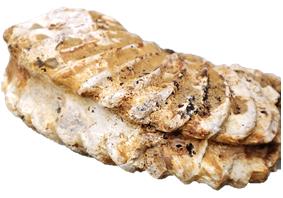
Description. A half-whorl of a reworked internal mold in whitish phosphate including grains of quartz, with the beginning of the body chamber and a trapezoidal section as tall as wide. The umbilical wall is rather low, sloping at 45°, flat, and extending to the flank via a rounded rim. Nine radially pinched, slightly projecting, proverse umbilical tubercles give rise to pairs of thin ribs curved forward. The rib terminations, slightly raised, reach a 60° angle to the siphonal line and alternate on either side of it. They terminate at the edge of a deep, U-shaped groove that gradually widens. This groove cuts into the venter even when traversed along an intercostal space. There are a total of 16 ribs at the top of the flanks.
Remarks. Personal discovery. This uncommon ammonite is a late variant of H. dentatus (Amédro, 1992; Amédro et al., 2014). It is found at the top of dentatus zone. In H. benettianus and H. dentatus, the raised terminations if ribs give the impression of a groove, but in general the venter is still convex or flat when crossed at the intercostal spaces. H. latesulcatus looks identical to H. dentatus in profile view, but its venter is hollowed by a deeper and wider groove, hence its name.