Created 2024/10/15
Updated 2025/10/02
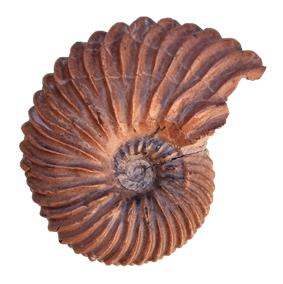
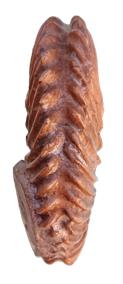
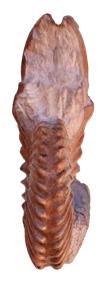
Hoplites (Hoplites) dentatus – Other specimen
| Measurements |
D mm | H/D | T/D | O/D | H/T |
|---|
| Jaffré 2007 p.75 | 60.5 | 0.48 | 0.37 | 0.23 | 1.27 |
| RJ-43 | 60.6 (52.7) | 0.44 | 0.33 | 0.22 | 1.33 |
| CP-626 | 65 | 0.42 | 0.32 | 0.28 | 1.32 |
| Age |
Origin |
|---|
Nodules of bed B
Top of benettianus zone
Middle Albian
|
Courcelles quarry
Clérey, Aube
France
|
Description.
The excellent preservation of RJ-43 is characteristic of bed B, with an internal mold of gray limestone and a brown test. This ammonite is very similar to the pyritic specimen CP-626, except that its ribs become almost straight on the last half-whorl and its ventral sulcus is deeper. It displays 19 umbilical bullae and 41 ribs near venter.
Remarks.
Specimen from the bed B of Courcelles, Aube, which contains fossiliferous calcareous nodules in grey clay. This bed marks the end of the benettianus zone, but Hoplites (Hoplites) dentatus appears from this zone onward, even if it is less abundant than H. (H.) benettianus. The layer of one meter above bed B contains rarer nodules, containing only H. (H.) dentatus or Douvilleiceras clementinum, often with an abraded side (Courville & Lebrun, 2010). This level forms the base of bed C and indicates the beginning of the dentatus zone. The ammonites in the rest of bed C contains almost exclusively clayey or pyritic internal molds of H. (H.) dentatus and its variants, such as CP-626.