Created 2024/11/20
Updated 2025/10/09
Hoplites (Hoplites) bullatus (J. de C. Sowerby, 1826)
| Measurements |
D mm | H/D | T/D | O/D | H/T |
|---|
| RJ-42 | 18 | 0.39 | 0.72 | 0.29 | 0.54 |
| CP-704 figured
| 54.1 | 0.41 | 0.79 | 0.33 | 0.52 |
| BM 37652 Spath 1923 | 60 (50) | 0.36 | 0.66 | 0.36 | 0.55 |
| Age |
Origin |
|---|
Grey clay, bed A, lyelli subzone
benettianus zone, Middle Albian
|
Courcelles
Aube, France
|
| Var. | devisensis | pseudodeluci | baylei
| benettianus | bullatus |
|---|
| H/T | 1.27-1.37 | 0.90-1.08 | 0.76-0.80 | 0.64-0.66 | 0.55-0.59 |
| T/D | 0.32-0.37 | 0.39-0.46 | 0.53-0.54 | 0.63-0.69 | 0.66-0.73 |
Description.
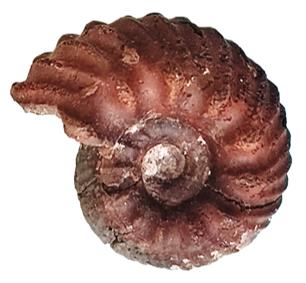
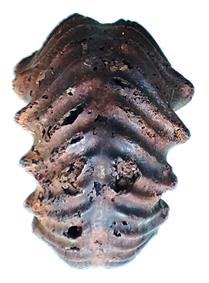
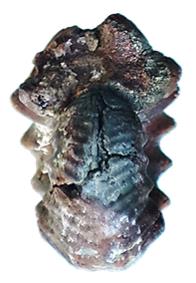
First, read the entry for Hoplites benettianus. This small pyritic internal mold is unfortunately undergoing decomposition. It is entirely septate, with whorls half-covered. The deep, stepped umbilicus has a quarter-circle wall. 12 radially elongated umbilical bullae arise from this wall, rise sharply at the umbilical margin, and give rise to two, sometimes three, proverse ribs curved forward. These ribs become lower on the flanks and then rise moderately near venter, resulting in slightly concave flanks. The ribs terminate near the siphonal line, with which they form a 60° angle. Their alternating terminations on either side of this line form a narrow, V-shaped groove. Including a few intercalary ribs, there are 38 ribs with an identical aspect at the top of the flanks. The section is reniform (kidney-shaped) between the ribs but low hexagonal at the level of the ribs.
Remarks.
The last table compares, by increasing thickness, the Hoplites with a narrow V-shaped sulcus of the benettianus zone, based on Spath's specimens (1925). No precise boundary separates them. They are considered today as variants of H. (H.) benettianus, which has anteriority (Amédro 1992; Courville & Lebrun, 2010; Amédro et al., 2014). The bullatus variant of the table, the most depressed and least frequent, is closest to the 0.54 H/T ratio of RJ-42. The ammonite comes from bed A of Courcelles, where small pyritic phragmocones are found instead of the famous ammonites beautifully preserved in the nodules of bed B. We note that our CP-704 and RJ-42 ammonites have an H/T ratio a little below the H/T range of the Spath specimens, which shows that all intermediates are possible.