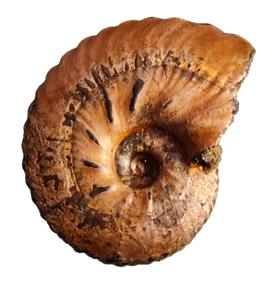
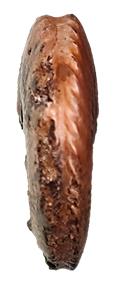
Euhoplites alphalautus Spath, 1925
| Measurements |
D mm | H/D | T/D | O/D | H/T |
|---|
| Neotype Spath | 33 | 0.45 | 0.31 | 0.25 | 1.52 |
| CP-712 | 42.5 | 0.46 | 0.29 | 0.28 | 1.55 |
| LFS 1360 Spath | 50 | 0.44 | 0.32 | 0.26 | 1.38 |
| Age |
Origin |
|---|
Grey clay, bed X
pricei zone
Upper Albian
|
Folkestone
Kent County
England
|
Description.
A small pyritic ammonite with a well-preserved face, whorls 40% covered, a compressed trapezoidal whorl section with slightly convex flanks and a narrow venter, with shoulders somewhat corroded by pyrite alteration. The umbilicus has a 60° sloping wall that rounds towards the flank. The umbilical margin bears 19 elongated tubercles inclined forward. Each tubercle gives rise to two or three thin, sigmoid, lautiform ribs, curved forward at the top of the flanks and terminating in a thick, blunt ventrolateral clavus, forming a 30° angle with the siphonal line. There are a total of 21 clavi and more than 60 ribs, including intermediate ones. Despite the abraded ventrolateral shoulders, the venter can be seen to have an open V-shaped cross-section, with a thin canal just over the siphon.
Remarks.
The table shows fairly stable proportions. Other Folkestone specimens very similar to our CP-712 can be seen: the 33 mm pyritic neotype from Spath (1926, pl. 25, fig. 16), a 38 mm phosphate specimen from bed X (Hadland, 2018, p. 71), and another pyritic sample of 25 mm on Jim Craig's site.
This species, which reaches 90 mm in diameter, is found at Wissant in the clay between levels P5 and P6, in P6, and in the clay layer just above, that is, the pricei zone and the base of the inflatum zone. Online, it is often confused with Euhoplites ochetonotus. It can be distinguished from the latter (see its entry) by a V-shaped ventral groove, a greater number of umbilical bullae (around twenty), more proverse and sigmoid ribs, and ornamentation that persists during growth.