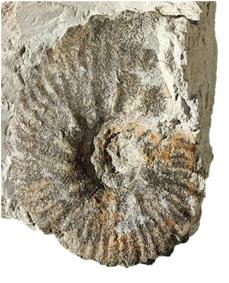
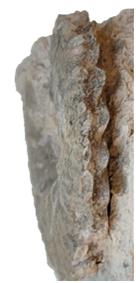
Dimorphoplites glaber Spath, 1926
| Measurements |
D mm | H/D | T/D | O/D | H/T |
|---|
| Holotype | 95 | 0.48 | 0.26 | 0.21 | 1.85 |
| RJ-1259 | 123.7 | 0.43 | 0.22 | 0.26 | 1.98 |
| Age |
Origin |
|---|
Marly bed, Argiles des Pommerats
biplicatus zone, Middle Albian
|
Yonne
France
|
| Var. | glaber | chloris | tethydis
| biplicatus | parkinsoni |
|---|
| H/T | 1.85-2.10 | 1.41-1.63 | 1.09-1.45 | 0.95-1.08 | 0.95-1.00 |
| T/D | 0.23-0.26 | 0.30-0.32 | 0.33-0.42 | 0.36-0.42 | 0.43-0.44 |
Description.
A very flat ammonite in light gray marl, slightly deformed, with whorls 60% covered and a test reduced to a brown to dark gray film. The beginning of the body chamber occupies the last 130°. The cross-section is trapezoidal and highly compressed, with barely convex flanks converging towards a narrow, slightly concave venter, bordered by prominent, rounded, subtriangular clavi parallel to the siphonal line and alternating on either side of it. The umbilicus has a low wall, sloping at 70°, and transitions to the flank with a broadly rounded edge.
The blunt ornamentation includes proverse umbilical bullae that gradually elongate. Each bulla gives rise to an average of three ribs, but one or even two tend to detach from their bulla, especially towards the end of the whorl. These ribs are convex at the beginning of last whorl and then slightly sigmoid. They connect in pairs to a ventrolateral clavus. On the last quarter of whorl, the ribs become difficult to distinguish, but in raking light, the bullae can be seen rising to mid-flank, as well as the point where the ribs branch. With a few additional ribs, there are a total of 13 umbilical bullae, 46 ribs, and 25 clavi.
Remarks.
Table 3 lists the Dimorphoplites with lautiform ribs, in order of increasing thickness and ornamentation, with measurements of the specimens from Spath (1926). They are found from the top of niobe zone to the base of cristatum zone. According to Amédro (1992), they are all variants of D. biplicatus, which has anteriority.
Four species from this series are illustrated on
Jim Craig's website.
In my opinion, his 44 mm D. chloris with blunt ribs is more likely a D. glaber.
There is no clear boundary between these variants, but our RJ-1259 corresponds to D. glaber according to Spath's description: H/T ratio close to 2, blunt ornamentation, and ratios between the number of bubbles, ribs, and clavi. However, it is possible that it is a D. chloris crushed during fossilization.