Created 2024/11/02
Updated 2024/12/01
Eubrancoceras quenstedti Knechtel, 1947
| Measurements |
D mm | H/D | T/D | O/D | H/T |
|---|
| RJ-615 | 42.3 | 0.33 | 0.32 | 0.40 | 1.03 |
| Holotype* | 40.0 | 0.40 | 0.34 | 0.35 | 1.14 |
| Brancoceras cricki | 46.0 | 0.38 | 0.32 | 0.38 | 1.17 |
* Dimensions measured on Knechtel's plates.
| Age |
Origin |
|---|
Pariatambo Formation
Unknown ammonite zone
Middle Albian
|
Huallanca
Ancash Region
Peru
|
Description.
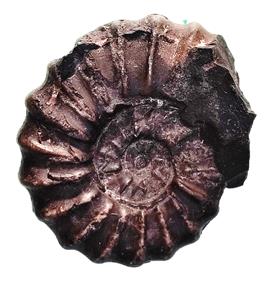
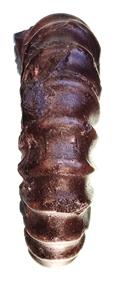
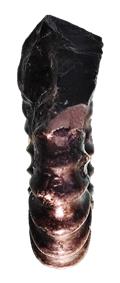
Evolute internal mold preserved in a bituminous black shale, without any test or suture traces. The whorls, one-quarter covered, slowly increase in height. Their section is moderately compressed, shaped like a rectangle topped by a semicircle, with indistinct ventral shoulders. The broad umbilicus, with a low, subvertical wall, clearly displays the internal whorls and is connected to the flank with a rounded edge. A rigid ornamentation of 20 simple, thin, and straight ribs, slightly proverse, with much wider concave interspaces, that originate on the umbilical wall and thicken slightly to reach their maximum height and width on the siphonal line. They cross the venter, forming a weak and broad rounded sinus.
Remarks.
Some Kennedy specimens (Fig. 5, J-L and holotype U-V) have sagged ribs on venter, like E. aegoceratoides. Others (Fig. 5, P-Q) have not, like ours.
Benavides-Cáceres (1956), Robert (2002) and Kennedy (2004) think the species is a variant with spaced ribs of E. aegoceratoides. But the suture in Knechtel has a main saddle twice wider as the first lateral saddle, whereas it is only slightly wider in E. aegoceratoides. Moreover, the exact level in Middle Albian is unknown, so the two species are probably valid.
At this diameter, E. quenstedti resembles Brancoceras cricki Spath, 1934, found in England, Aube (Matrion, 2010) and Texas (Kennedy et al., 1999), in the biplicatus zone of Middle Albian: same proportions, same spaced ribs, very similar sutures. Although B. cricki has traces of a ventral keel around 5–15 mm according to Spath, Owen (1971) considers the species to be a Eubrancoceras. Furthermore, the B. cricki specimens from Spath and Matrion have rursiradiate ribs at the end of the spiral. These differences being finally minor, it is possible that E. quenstedti and B. cricki are conspecific. We added the measurements of the holotype of B. cricki in the first table.