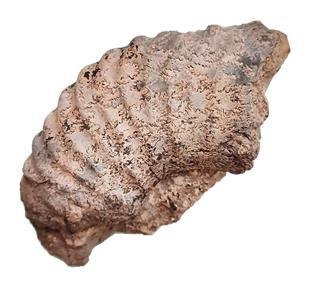
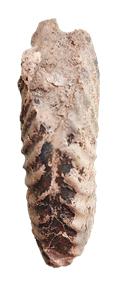
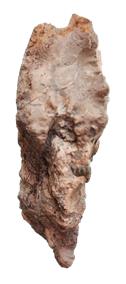
Anahoplites praecox Spath, 1923
| Measurements |
D mm | H/D | E/D | U/D | H/E |
|---|
| Holotype | 20 | 0.45 | 0.35 | 0.25 | 1.29 |
| LFS 342 Spath 1925 | 50 | 0.36 | 0.24 | 0.25 | 1.50 |
| CP-545 | -- | H = 36.7 | E = 25.4 | -- | 1.44 |
| Age |
Origin |
|---|
Bed F, sandy limestone
A. intermedius zone
Middle Albian
|
Courcelles Quarry
Clérey
Aube, France
|
Description.
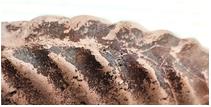
Quarter of whorl of an internal mold in gray phosphate, with clearly visible sutures. The high trapezoidal section has flanks that are initially flat and parallel, then convex and converging towards a flat venter with distinct shoulders. The profile view is that of a compressed Hoplites dentatus. The umbilicus with a straight wall sloping at 50° has an edge which rounds towards the flank and carries 6 stretched bullae, slightly proverse, with a triangular profile. Each gives rise to two slightly prominent ribs, at first almost straight, then curved forward at the top of the flanks. But while the rib terminations are elevated and delimit a ventral groove in H. dentatus, here they sag on the shoulders of the flattened venter, without forming a sulcus. Another difference is that the rear slope of the ribs is steeper than the front.
Remarks.
Personal discovery. Individual similar to those of Spath (1925, pl. 11, fig. 3) and Young et al. (2010, pl. 31, 2a-b). The broken venter at the end gives the illusion of a furrow on the venter and aperture views, but it is flattened on the intact part, see the photo on the right. For Amédro (1992) and Amédro et al. (2014), A. praecox is a robust variant of A. intermedius (see its file), thicker and with stronger ribs. It retains from H. dentatus, from which it derives, its ribs which are still curved forward instead of being more or less sigmoid.