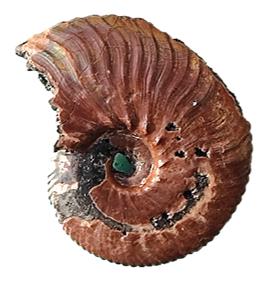
Anahoplites daviesi Spath, 1925
| Measurements |
D mm | H/D | T/D | U/D | H/T |
|---|
| Holotype at 33 mm | 33 | 0.48 | 0.20 | 0.21 | 2.40 |
| CP-718 | 40.7 | 0.45 | 0.25 | 0.24 | 1.82 |
| Holotype at 48 mm | 48 | 0.39 | 0.21 | 0.35 | 1.86 |
| Age |
Origin |
|---|
Grey clay, bed VII
D. biplicatus zone
Middle Albian
|
Folkestone
Kent
England
|
Description.
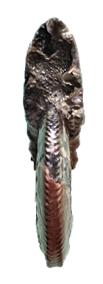
Pyritic phragmocone with highly compressed whorls, 50% covered, a partially preserved pearly test, and a venter chipped along a part of the last half-whorl. High trapezoidal whorl section, with slightly convex flanks converging towards a flat venter. Narrow umbilicus with a low wall sloping at 70°, passing to the flank via a rounded edge. Up to the beginning of the last half-whorl, minute umbilical bullae, shaped like proverse commas, are present, along with very closely spaced small ventrolateral clavi, forming a 45° angle with the siphonal line. Very weak ribs, effaced in the middle of the flanks, connect the two rows of tubercles.
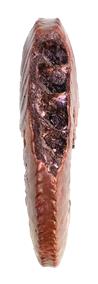
On the last halfwhorl, the umbilical bullae strengthen but remain small. Each gives rise to two falcate ribs, not very prominent but clearly visible on the flanks, each ending in a clavus. They are initially faint, then well-defined on the last quarter of whorl, with a gentle anterior slope but a steep posterior side. The profile view shows fine riblets which are in fact the crest lines of these ribs. Simultaneously, the umbilicus tends to open, and the ventrolateral clavi become almost parallel to the siphon.
Remarks.
According to Spath (1925, p. 152), this species from the upper part of the D. biplicatus zone resembles A. planus (see its entry) up to about 20-35 mm, particularly the small umbilicus. Approximately half a whorl before the body chamber, more prominent bullae appear on the edge of umbilicus, which tends to open, along with falcate ribs on the flanks. Its rib density and strength are quite variable. Our specimen corresponds to the elegans variety, with fine and numerous ribs, illustrated by Spath pl. 14, fig. 7. To my knowledge, this ammonite has not been found in Aube.