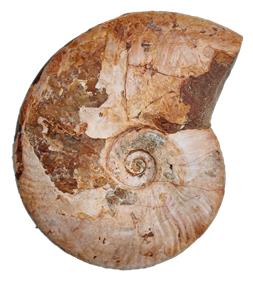
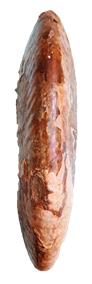
Aioloceras tenuicostulatum (Collignon, 1963) – Other specimen
| Measurements |
D mm | H/D | T/D | U/D | H/T | Ribs |
|---|
| CP-20 |
48 | 0.50 | 0.31 | 0.19 | 1.60 | 42 |
| Holotype |
79 | 0.49 | 0.29 | 0.19 | 1.69 | 45 |
| CP-141 |
102 | 0.49 | 0.26 | 0.17 | 1.86 | 61 |
| R. Touch |
102.5 | 0.51 | 0.26 | 0.18 | 1.96 | 59 |
| CP-646 |
123.4 | 0.48 | 0.26 | 0.19 | 1.87 | 58 |
| CP-338 figured |
243 | 0.43 | 0.21 | 0.25 | 2.03 | 72 |
| Age |
Origin |
|---|
A. besairiei zone
Lower Albian
|
Ambatolafia, Boeny Region
Madagascar
|
Description.
Very large discoid ammonite, 24.3 cm in diameter, with the test mostly preserved on one side. The beginning of the body chamber occupies the last 60° and the whorls are 60% covered. The very high lanceolate section diverges slightly up to 40% of the flank height, forming a peri-umbilical flattening, then converges towards a narrow, arched venter. The umbilicus has a low, straight wall, sloping at 80°, and a narrowly rounded, almost angular edge. There are 72 closely spaced, falcate, blunt ribs, clearly visible on the first half of the last whorl and discernible thereafter only in raking light. They begin indistinctly some distance from the umbilicus and gradually become more prominent. There are some bifurcations in the outer half of the flanks and shorter intercalary ribs here and there. All the ribs are similar at the top of the flanks and lower on the narrow venter.
The test exhibits six weak constrictions, in the form of a slightly deeper and wider intercostal space. These form flat, broad bands on the internal mold, as seen at 11 o'clock in the profile view. The highly compressed whorl section and the numerous ribs allow this specimen to be classified as belonging to the species.