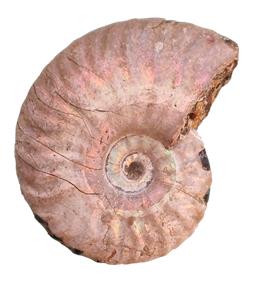
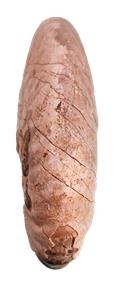
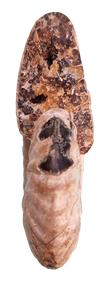
Aioloceras morganiforme – Other specimen
| Measurements |
D mm | H/D | T/D | U/D | H/T | Ribs |
|---|
| CP-720 |
52.9 | 0.48 | 0.34 | 0.22 | 1.42 | 26 |
| CP-21 |
56 | 0.52 | 0.34 | 0.18 | 1.53 | 25 |
| CP-719 |
68.1 | 0.49 | 0.30 | 0.24 | 1.64 | 32 |
| CP-719 |
(56) | 0.50 | 0.35 | 0.26 | 1.41 | 32 |
| Holotype |
79 | 0.49 | 0.32 | 0.22 | 1.56 | >34 |
| CP-159 |
93 (86) | 0.47 | 0.32 | 0.23 | 1.45 | 38 |
| Age |
Origin |
|---|
A. besairiei
Malagasy zone
Lower Albian
|
Ambatolafia
Boeny Region
Madagascar
|
Description.
See first the description of specimen CP-159. The younger specimen CP-719, 68.1 mm in diameter, is completely septate and covered with a nearly complete pearly shell that hides the suture lines. On the view of the aperture, the right flank is crushed, which overestimates the height/thickness ratio of whorl section. We have therefore added more realistic measurements to the table, for a diameter of 56 mm. The specimen is very similar to CP-159, except that it has less attenuated ribs on the siphonal line, a few very short intercalaries on the outer third of the flanks, and irregular spacing of the ribs on the first half of last whorl.
Remarks.
As with Aioloceras besairiei, the measurement table shows that the number of ribs tends to increase and the T/D ratio to decrease with growth.