Created 2023/02/06
Updated 2024/06/25

Ammonoidea – Shell description

measurements

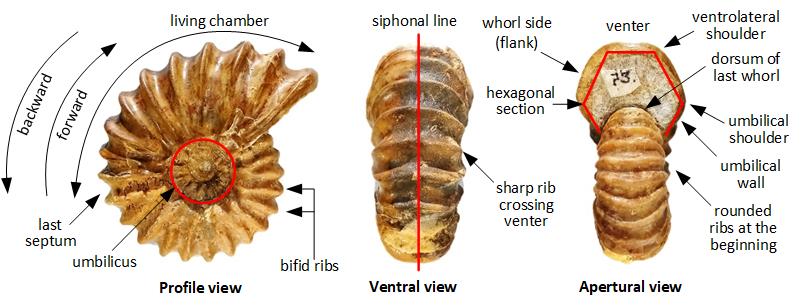
The plate depicts a Protohoplites (Hemisonneratia) cantianus Casey. The venter is the peripheral (external) part of last whorl, while the dorsum is the invisible part, in contact with the previous whorl. The helical line of overlap of successive whorls is the umbilical seam or umbilical suture. Each side of whorl has often two blunt angles or stronger curvatures, the umbilical and ventrolateral shoulders.

From inside to outside are found the umbilical wall, the umbilical edge or shoulder, the flank, the ventrolateral shoulder and the venter. The umbilicus is the depression between two opposite points of umbilical edge. The siphonal line follows the middle of the venter. It corresponds to the location of the siphon, hidden under the test.

From any point on the shell, a move in the direction of coiling (toward the aperture) defines the forward or adoral direction. An opposite move toward the apex (origin of whorls) corresponds to the backward, apical or adapical direction. The upper part of a flank is near venter, while the lower part is close to the umbilical edge.

The most frequent photo in literature is the profile view or side view or lateral view. It unveils for instance the overlap of whorls (the involution), the size of umbilicus, the shape of the ribs, the possible presence of tubercles, and the whorl expansion ratio. The ventral view shows how the whorl thickens and the aspect of ribs on venter: interrupted or not, with a longitudinal groove (sulcus), a forward projection (sinus), a keel, etc. The apertural view, or front view, also allows to assess increase in whorl thickness. Additionally, it shows the shape of whorl section and the slope of umbilical wall.

Collectors and sellers often misidentify their specimens by relying solely on the side view of another fossil on the Internet, while the section and ornamentation of the venter can be very different. For example, Hoplites (Hoplites) dentatus and Hoplites (Isohoplites) steinmanni (see their entries) appear identical in profile. In reality, a ventral sulcus interrupts the ribs of the former, with alternating terminations on either side of the siphonal line. The ribs of the latter cross the venter without interruption in the adult. Hence the importance of having two or three different views!

Even worse, some species are strikingly similar. For example, Beudanticeras newtoni and Beudanticeras beudanti (see their entries) are two compressed and ribless Albian species, identical in shape and therefore often confused. However, the former is confined to the Lower Albian while the latter is found in the Upper Albian. In this case, knowledge of the collection stage (Albian) is insufficient: it is also necessary to know the substage or ammonite zone, which is not always possible. Fortunately, the two forms can be distinguished by their suture lines, which are more deeply incised in B. beudanti.